4-way stops are terrible in general. They train people to think "I stopped, now I can go", which is dangerous when someone confuses a normal stop for a 4-way stop. It also wastes a good bit of energy.
Four way stops are good, in my experience, at intersections with roughly equal (low) traffic load on both (two-lane) roads and relatively high pedestrian traffic. Like in a dense residential urban neighborhood between major commercial thoroughfares, side streets. Traffic is mostly people going to residences with people out and about walking. If it’s only a two way stop drivers will often not yield to pedestrians on the free flowing road.
Four way stops on intersecting four-lane roads are awful for the reason you stated.
To use Chicago as an example because I know it, typically major roads are spaced every four blocks (half mile) with smaller roads in between. The mid-point roads (two blocks from each major one) is often a little wider than the other two side streets on either side, and those intersecting mid-point roads usually have a four way stop while the two smaller ones will have stops signs where they cross a mid-point road but the mid-point road will not. You end up with a nice, overall hierarchy that generally works well.
> If it’s only a two way stop drivers will often not yield to pedestrians on the free flowing road.
I’m up in Ontario, Canada. You’re not supposed to yield to pedestrians on the free flowing road. The pedestrian at the stop sign stops and waits for a break in traffic.
Yeah maybe for a few moments. So what? It's a low volume approach. Sometimes people gotta wait and sometimes waiting to let a massive traffic flow get through quickly is the better way to prevent larger traffic problems.
That isn’t the rule either, I guess parent made their point. The first person who stops goes next, right away only matters if their is ambiguity in who stopped first.
This is not correct. There are clear instructions on how a 4-way stop should operate and its yielding to the right, if opposite cars are both moving forward, both can go, otherwise the car who has initiative has the right of way. Every driver must come to a complete stop.
I’ve never seen a four way stop in a region that had traffic on the right can always go regardless of stop time. But I’ve only seen four way stops in a few countries.
Having moved between states and taken a lot of drivers tests. I can say the exact rules are something that vary between states and over time. Including how it was taught.
My first drivers test was yield to the right. Later it was fifo order of who made it to the stop.
My running interpretation is fifo order with yielding to the right in case of ambiguity.
There are 10,000+ roundabouts in the US and the number is growing rapidly. One could argue they may even be overused in certain areas (exhibit: Carmel, Indiana).
What's the significance of roundabouts per square mile? It seems pretty meaningless if I'm honest. There's huge swaths of rural land where roundabouts are totally unnecessary.
There are also huge swathes of city, much like other countries.
At the same time, the US is much larger than most, so "There are 10,000+ roundabouts in the US" isn't very significant. A proportion would thus be a better metric here than an absolute number.
If you have numbers on intersections per country, and what proportion of them are roundabouts, that would be better, but I don't, so I'm using land as a proxy. I would also accept sum total road length as an option for denominator.
Roundabouts are great (we just had two complex intersections with traffic lights replaced by roundabouts and the traffic flow is much better), but they take significantly more space than a 4-way stop.
The only places where a 4-way stop has room to make a roundabout are places where there is not enough traffic for it to matter either way.
The biggest obstacle is that there are just too many 4-way stops in urban areas where there is no space left to make a roundabout, you would have to tear down buildings. I don't think that is a valid argument in that scenario.
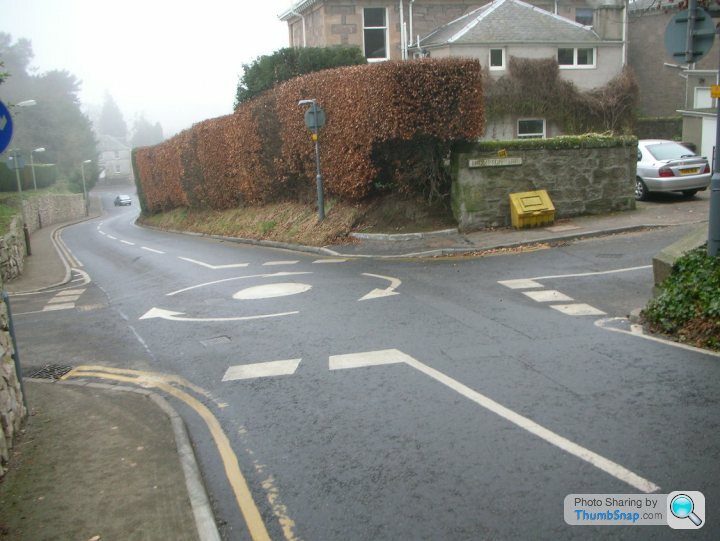
The more I look at that... Isn't that basically just a four-way yield, and the markings are mostly superfluous? You're basically doing the same motions in a regular intersection.
I guess that's the point, and the markings are just to give drivers the intuition of treating it like a regular roundabout (yield to your left [or right in the picture]).
> the markings are mostly superfluous? You're basically doing the same motions in a regular intersection.
The image linked, yes. However I've never seen one quite like that in the US. Instead where I'm at we have a small circular barrier in the center of the intersection (and some very eye catching reflectors) that you actually have to drive around. It's a very good design (imo) because it physically forces vehicles to slow down and swerve so there's no way to inadvertently blow through it at speed the way that sometimes happens with a 4 way stop on a long straightaway in the dead of night.
The space requirement is only slightly higher than the one linked above, still much less than a proper full size roundabout. It's basically a cement barrier sticking 1/4 of the way into your lane.
It's not necessary to stop if there's no car to the right (as this is left side driving), if there is but it is turning left, or if an oncoming car is turning left or going straight.
Yes. The markings are part of the road language. E.g. the X in the road with Keep Clear doesn’t actually do anything. It won’t keep you clear. You have to keep clear when you read it.
That requires a level of consideration for others that your average American simply cannot comprehend. No stop sign means you have unlimited right of way bestowed by god himself and fuck anyone and everyone else.
The other option is the person who sits at a 4-way stop until all traffic in a one block radius stops before they move, totally ignoring right of way and all sense of safety and propriety.
They make people on the main road slow down, which is a feature, not a bug. What you mean is that they're the most efficient at what they do when the traffic is comparable. They only reduce accident at the expense of a slightly lowered throughput if the traffic is highly disparate.
If the volume is disparate, then the road with less traffic can wait... kind of like a stop sign! Except the road with more traffic won't back up and cause massive problems.
If the traffic intensity of the main flow is so high, that there are never any gaps, then it is near the saturation and will cause traffic jams anyway. Which first needs to be fixed anyway and second will also cause gaps to be created again, because the main flow comes to a halt.
> Right but it's not like a 4 way stop is going to perform better.
A 4 way stop does perform better than a roundabout given highly disparate traffic volumes, because roundabouts suffer from resource starvation in that scenario, but 4 way stops are starvation-free.
If this is the case you can install stop lights and traffic sensing at roundabout ingress points, you can also provide a "turn right" lane that bypasses the roundabout entirely. Intersections are dangerous.
> If this is the case you can install stop lights and traffic sensing at roundabout ingress points
But those options are a lot more expensive and need a lot more maintenance than just a regular roundabout or four way stop.
> you can also provide a "turn right" lane that bypasses the roundabout entirely.
How would that work? Consider a 4-way roundabout, where there's a constant flow of cars from west to east, and one car from the south that wants to go north but can't because of the starvation problem. None of the involved cars would want to use a "turn right" lane.
Putting a stop sign or traffic light in your scenario will just cause traffic jams. If the density is low enough to allow flow with a gap created by a stop sign, without causing traffic jams, then there will also be gaps for the secondary flow.
Because retrofitting them properly requires emminent domain. The ones they shoehorn onto former four way stops are so useless. They are so tight you still have to face a stop sign vs being able to just seamlessly zipper merge in a proper larger circumference roundabout. When they have room to build out a proper roundabout they are usually OK but that is hard to do outside say new suburban construction due to lack of available land on the right of way.
Even rural Georgia has double roundabouts now. Not sure why people on the internet can't contain their glee at stating the US is "allergic" to them when the frequency of roundabouts has grown significantly in recent decades.
So use a mini roundabout. They are common in the UK. It's just a painted circle with a slight hump, in the middle of a four-way junction. Vehicles can drive over it (and larger ones have to) but it indicates to everyone that they have to give way to traffic from the right and don't have to stop otherwise. They typically aren't big enough for multiple vehicles to be turning a corner at the same time. They fit anywhere.
Yes, and they can be smaller. The circle is about the right size but it has lots of room around it. Imagine a crossroads at the meeting of two residential streets, both just wide enough for two cars. Stick the circle from your picture in the middle of that imagined junction. That's what the mini roundabouts are like on the 1930s suburban estate I live next to.
What is the traffic flow rate in an intersection with a 4 way stop? For single lane, since only one vehicle can be in the intersection at once, and probably takes _at least_ 5 seconds to start from stopped and cross the intersection, I'm guessing in the 10-12 region per minute best case, so maybe 600 an hour?
Now if you convert it to a mini roundabout, you can have at least two vehicles in the intersection at all times. I fail to see how it wouldn't be an improvement.
I think you are making lots of assumptions here, like when I say space, I guess you assume it is still perfectly flat and the roads are perfectly aligned? The particular four way I'm thinking about, which really should be a traffic circle if they could blow away some houses, is 65th NW and 3rd in Seattle:
So notice we already have problems in a bad alignment of 3rd, and 65th is basically a steep grade, even coming up form the west. I think you could put a circle in if it were flat, even with the bad alignment (or maybe because of the bad alignment), but this hills make a non-starter. It also gets enough traffic that I'm pretty sure they are just going to put a stop light up eventually.
Here in the UK, we've got lots of roundabouts from tiny mini-roundabouts (some of which have four junctions) that could easily fit almost anywhere, all the way to gigantic multi-roundabout junctions (https://en.wikipedia.org/wiki/Magic_Roundabout_(Swindon) ).
I can't think of a situation where it's more efficient to have four vehicles all stop at a junction (busy four way stop) vs a roundabout which will allow one or two vehicles to join the roundabout without having to stop.
You don't have this? In Sweden we have sensors to detect cars, pedestrians and bicycles to shift the lights as appropriate. During rush-hour those features are turned off/discarded in favor of "grid optimized" timings. In Netherlands they prioritize pedestrians and cyclists when it's raining.
We also have LED lights in our traffic lights which I've come to understand is a saftey hazard in USA because snow falls sometimes.
Because those systems are exorbitantly expensive and require digging up the road to install sensors. If there's a stop sign instead of lights, you need to dig up more private land to run power and set the utility poles to hang the lights from.
A stop sign costs like a hundred bucks, you stick it in the ground, job done. Installing an automated traffic system takes multiple days, a full crew, and heavy equipment.
Plus I'm sure that in today's capitalist hellscape it's also a subscription service that your tax money needs to pay monthly, likely for every individual intersection. Stop signs need maintaining every decade or two.
The answer is money and who's willing to part with it.
Assuming you're referring to the US, we do. They're all over the place. But they're a lot more expensive and complicated than roundabouts and depending on the traffic pattern they can still be less efficient.