I am one of the UPower founders. The key takeaways here are that the main hindrances to novel nuclear are (1) meeting regulatory and safety necessities without huge testing costs, which also require a customer interested in purchasing, and (2) competing with the grid, (3) huge scientific/technical risks if not yet proven.
UPower meets these by
(1) being small enough to build a very tough, full scale emulator for testing, never before done in nuclear.
(2) not competing on the grid, which gives immediate, in need customers which is also necessary for regulatory process to complete in (1).
(3) using technologies and materials with decades of experience, in a new way, eliminating the huge uncertainties of many startups you see in the news.
A couple side notes on TC article specifically for those interested:
1) NO reprocessing as somewhat indicated in article ("processing"). We use the low enriched used fuel from the reactor to make new fuel for the next deployment. We don't isolate dangerous parts as done in reprocessing which is the main concern with reprocessing.
2) True waste elimination- it's not just "less of a pain", which is definitely good: the reactor actually eliminates waste instead of just using it for fuel as some thermal types do (eg some startups seen in the media). Without fast neutrons, a reactor cannot burn the longest-lived parts of waste.
3) History on reactor regulatory process: Never before has a reactor been fully built and operated before licensing as somewhat indicated in final paragraph. That would cost $Bs. So, in all history of nuclear, they have built scaled models and spent hundreds of millions in scaled testing and modeling to prove that the scaled tests are accurate to what the full reactor will be like.
The UPower test reactor can be built to full scale for on the order of single digit $millions, which can be said with confidence because even a national lab built a similar reactor and produced electricity with tons of red tape for $100s k.
The heat transfer process has no moving parts and can be shown at full scale and tested to failure on the order of just $thousands, unlike the big boys with outrageously complicated flow loops, pumps, valves, secondary pumps, etc etc etc.
This means the UPower reactor has a chance at being the first commercial reactor able to use the streamlined "license by test" process.
#1 sounds awesome, our senior design project was on continuous pyroprocessing of HLW SNF in order to retrieve the remaining enriched Uranium while leaving the rest as proliferation-resistant waste. I'm not sure what techniques you are using (UREX?) to extract the LE uranium for reuse -- but I assume the "main concern with reprocessing" you're hinting at is the extraction of proliferation-enabling material as well. If you're doing #2 then I am wondering how much reprocessing you are really having to do at all.
2) True waste elimination - I am very curious how you are able to do so. It seems like a very big neutron poison for fast neutrons. I'm not sure if you're using a thermal/fast reactor with gas/molten salt/water as the cooling material. I will await for the NRC filings, I suppose!
> ... the reactor actually eliminates waste instead of just using it for fuel as some thermal types do (eg some startups seen in the media). Without fast neutrons, a reactor cannot burn the longest-lived parts of waste.
What's your source of fast neutrons?
Also, is it accurate to describe your product as a nuclear battery? The TechCrunch article refers to it generating heat (as opposed to electricity), so is "nuclear reactor" a more accurate description?
fission. :) it can run several fuels as described in article.
Battery seemed to have stuck. it's not my favorite. I would say generator. battery apparently seems more innocuous.
Battery also feels accurate because the reactor will be more or less "plug and play" like a really, really, really long lasting battery that produces the same amount of power. It can also be used in "packs" like a battery.
Fundamentally, nuclear, just like coal or anything else is a source of heat. With different secondary packages, you can produce electricity or cogenerate steam.
Hi. First of all, best of luck with your startup. I'm all for better nuclear technology.
However, I'm related to a nuclear engineer (who is currently in a senior position at IAEA, thus the anonymous account), and I understood that both steps you're currently undertaking were commonly know to be viable and efficient, BUT contravened most non-proliferation agreements (note: I'm not a nuclear engineer or physicist. Just interested).
So, you're "disrupting" an industry in dire need of disruption (due to the massive amounts of red tape), but you're also walking a tightrope.
I believe what you're doing is safe and needed, but if public opinion or perception turns against you (any article hinting at terrorist use, for example, or concerns over breaking the Nuclear Non-Proliferation Treaty), it might end your company.
You probably have taken all of this into account, and I hope you have a strategy in place on how to deal with this :) .
Once again, I wish you best of luck and I hope to use your generators in the future !! :)
EDIT: I haven't talked with my relative yet, all what I wrote above is my (probably misinformed) opinion.
Second edit: It seems several others have already raised most of my concerns, and better than I have. I've also
Thanks so much for the luck wishes! We will try to make the most of this luck. ;)
I'm glad you brought up the dirty bomb factor again.
The perpetuation of the myth of the dangers of the dirty bomb is truly sad. We all intuitively realize that the dangers of chemical warfare, biological dispersion (especially because it is transmissible long after the incident), and the dangers of bombs themselves are so much greater than some amount of radiation that decays rapidly and, by the nature of a bomb, is highly dispersed.
As an example of the worst possible radiological contamination (which would not practically be achieved by a dirty bomb to scale), read about the story of the "Atomic Man". In an instant, he received 500 times the "lethal lifetime dose." He died at 75 of unrelated causes. The atopsy showed zero cancer. The chemicals were terrible. the explosion was terrible. Ultimately the radiation itself was not as bad as expected.
In another example, studies showed mice fed plutonium dust had their lives expanded by 120%. See here for an overview of these types of studies and natural effects of hormesis. http://www.radpro.com/641luckey.pdf
It's my belief this disproportionate fear is really a tragedy, a play on the fears of uneducated people (again, fed by media since anything nuclear is like sex or plane crashes) that may ultimately cheat them from peace of mind and clean, reliable energy sooner. What if people refused transportation:vehicles, trucks, and planes because gasoline is highly combustible and kills so many per year? Our economy exploded with oil at the turn of the last century.
But that's a side point, sorry for digression.
Could this be blown up?
1) it's underground
2) it's surrounded by concrete that has been tested to be safe to drop from hundreds of feet in the air
3) it's a solid metal block. It doesn't have dispersion capabilities like other forms.
Unrelated fact since we aren't reprocessing: It's a common misconception that reprocessing is not legal in the US. It is. Also for instance, France does it and has been doing it for a while.
It is not me who you have to convince! :) It's the general public (and fighting decades of propaganda).
Maybe a YouTube viral video or something, I don't know :)
I wouldn't go showing the plutonium dust article. Reminds me too much of Alexander Litvinenko.
And your point about reprocessing in France actually reinforces my point: it required multiple inter-governmental agreements at the highest diplomatic levels, and complying with EURATOM, very especially (as it applies to you) the 2001 Joint Convention, OSPAR (?) and I'm sure plenty more of red tape (source: IAEA publications).
Being U.S. based is obviously a benefit to you, since they're the most likely to shrug international oversight (and you say you're not reprocessing anyways).
Plus, France is the most pro-nuclear country in Europe.
I saw the diagrams on your website, it does look like a very unlikely target for being blown up, but the likelihood doesn't enter the equation when irrational fears are bandied around (they might say you're lying, etc..).
I just want you to be very aware of the stigma and irrationa l fears, and the regulatory hazards, because I very much want you to succeed.
I've talked to politicians (outside the U.S.), and they tell me that pushing a nuclear agenda, while economically sound, is political suicide. Some countries have a "stealth" approach (simply by not calling attention to media and quietly "expanding" current facilities), while others, like Germany, caved in to public pressure.
Absolutely. We talked to German energy heads that said they would invest but wouldn't tell anyone. :)
One thing we could use a favor from you. So, so so many people are saying "I support nuclear but I'm the only one"... you aren't! Believe me you're in the majority (70% in US support, although nuclear especially needs people like you, in the top of that group in knowledge/education to speak out and help educate) and that even this is changing... and just come out of the closet already. :)
This seems like an interesting technology, especially if you can keep the moving parts to a minimum. I did a bit of research on mineral extraction. Not surprisingly the more refined your minerals the more valuable they are, and building an on-site blast furnace to convert various forms of iron ore into pig iron would allow countries like Afghanistan extract more value out of their mineral deposits. The challenge is that without infrastructure the traditional solution is build a mine, build train tracks to the mine, and then transport raw ore from the mine to the processing facility (this is being done in some of China's western provinces). Primary issue of building a refinery is a reliable source of power. One key is unattended operation. Is that something you are planning for?
Great assessment and distilled description. We have literally spoken to people from lithium mines to chromium mines to remote oil or copper mines and they have explained this same predicament of difficulty of reliable power on site.
As far as unattended: in sum, the technology allows it, but the regulatory structure may not be comfortable with it in the near term. It's not the deal breaker you might think in terms of economics. We are talking about more reliable power at multiples less with prices that don't require the complicated hedging and regular bulk purchases as oil and gas. Generally, we are looking at staffing structure similar to oil rigs- weeks on, weeks off. As regulators and public understand operation, we could transition to remote staff managing sites. Truth is that the technology shuts itself down in case of any bad event (see EBR for similar, really amazing) and there would be almost nothing for on site personnel to do, but there is a perceived safety blanket with having a warm body on site.
I think the key-est takeaway is the need to persuade people not to be terrified of nuclear energy. That's likely to require an effort on a par with any technical advances you make.
Realizing the cost advantage of fission will change minds pretty quick. Of course there's the catch-22 of being able to do it before their minds are changed. uPower's plan of trying offgrid first may be worth a shot. A little understanding of FUD psychology can help too. Today's nuclear industry flunks on that. Telling people nuclear is safe is a classic mistake. Safety is a feeling, and it's hard to feel safe about things you've never touched and can't even picture. There's virtuous feedback here too -- more reactors around, more people who see them and stop fearing them. A charismatic CEO who can stand on top of a reactor on YouTube can't hurt either.
You're absolutely right that safety is a feeling, and we are thinking like you that having a full scale prototype that people and regulators could see, hug, feel, and basically test drive will help. It's just not big and scary. In fact, the amount of heat produced by the reactor a day after shutdown would be on the order of a hundred hair dryers. Sounds cozy :) loud but cozy.
Where the industry has failed in engaging new types of social media (HN, YouTube, reddit, quora, etc) people are stepping up. And honestly it's probably better this way.
On a side note, people don't realize but there's no big nuclear industry really. Our founders have met and spent time with executives from nearly every domestic utility company and all of them have different types of power in their portfolio. They have no real interest in promoting nuclear over coal. The uranium miners make no money compared to coal mines because, think of it, one two-millionth of the volume of nuclear materials is needed compared to the volume of coal. You've never seen a uranium train car, because reactors don't need to burn hundreds of train cars a day and put that in our air.
Compound that with the fact that anything nuclear is like sex and plane crashes for news media. :)
So it's a battle to get education out, but smart people like you on HN will win the day. I really believe it.
Also our charismatic CEO will do his best to stand on a reactor for you ASAP.
Great point. It's so true. It's exciting that having nuclear backing from groups like YC help people be less terrified (another nuclear group in YC is Helion!). Some great documentaries like Pandora's Box (on netflix) are helping. And generally, i think people are sometimes just relatively growing "less terrified" of nuclear than global pollution, climate change, ocean acidification etc.
I think it's very important that businesses engaged in development and application of nuclear technology pursue public education more vigorously.
Public level of understanding of nuclear technology is depressing. The past fear campaigns and decades of life in fear of nuclear annihilation during the cold war have spread the knowledge of fear-inducing properties of nuclear materials like very long half-life of the waste, but kept people largely unaware of other important facts like means to reduce half-life of the waste, natural existence of background radiation, our consequent evolutionary adaptations to it or the inverse square law. This creates the perception that even properly regulated nuclear technology is a lot more dangerous than it actually is.
I am pleased to see a company like yours cropping out of YCombinator. Not for nothing but: get some help with your website. It might seem like such a frivolous thing, but having a well-designed website goes a long way (or rather, having a bad web design mars your authority and reputation undeservingly).
Ouch. :) you're dead on. we've tried to be one of the companies that focus more on doing than publicizing... but it's definitely not good if it mars reputation. Thanks for comment.
I studied energy at Stanford and joined the team that spun TerraPower (www.terrapower.com) out of Intellectual Ventures with Bill Gates' backing. I spent a lot of time looking at these nuclear batteries and economically it's very hard to see them working out as anything close to competitive to natural gas, coal, or wind. The amount of security, containment, etc. that you need for a large plant vs. a small plant doesn't vary much, so the costs per kWh don't scale down as you move down in total plant size, they scale up - and the idea as the techcrunch article suggests that you could sell just a "thermal" battery and let the utility or whoever add the actual steam-to-electric conversion on their own is laughable. Utilities don't do anything on their own.
I do hope these guys figured out something novel about the economics -- and I certainly applaud YC for going into energy.
They're aiming at niches where they won't be competing directly with more conventional power plants. Their web site claims [1] that it's intended "for remote and distributed generation where energy costs can exceed 30 cents/kWh, and power is needed 24/7".
Precisely right. Traditional utilities want something with a long operating track record, something hard for new designs to do off the bat. But going where the reactor is 5x cheaper than the next best option changes that. Plus many of these places want combined heat and power, so the design needs to be flexible on the thermal end.
there's definitely an opportunity in providing thermal at factories. lots of remote sites in India and China have their own purpose-built coal plants that could potentially use something like that...I have a harder time seeing the financing line up for serving remote villages that can't afford any power today. In those cases finance will always flow to smaller increment technologies, even if they're higher $/kWh, like solar + battery or diesel
The amount of security etc. required per site is subject to change. But even a 1GW site can be more cheaply assembled from 300 units coming off an assembly line than from one unit built in-place. The economics of this were discovered in the 18th century.
Are size and efficiency the most pressing issues to solve in nuclear power? I don't know a thing about nuclear issues but from the layperson's perspective, it seems like security is the biggest problem that keeps nuclear power from being used everywhere. These containers are essentially dirty bombs without detonators and must be protected as such. This might work for the military, where you could secure one on a restricted section of a FOB, but how would this work for a small town in Alaska, as the article suggests? Securing the site is only half of the problem, too. You also have to secure the supply chain for the nuclear material, as well as the disposal. The cost of disposal is another challenge. Imagine the difficulties of transporting the spent fuel from the Alaskan village.
These guys have a big challenge ahead of them but it would be quite awesome if they can pull it off. Prime power generation and the supply chain issues that its fuel entails is a huge and extremely expensive problem for the military. If you could safely build this in a CONEX, that would be impressive.
Commercial power reactors are very expensive initially (multiple billions). This is a huge barrier to entry for most power plants. So the thinking is if the size can be reduced so can the cost.
The military is interesting because they already have small reactors in submarines and ships. And they have access to the highest grade fuel because they don't have to follow power plant regulations. So it seems like if these modular reactors would be useful to them, they could easily adapt these reactors for land use.
This startup is hard to gauge because there's so few actual details about their design. For example, how are they going to use thorium as a fuel? You can't just use thorium without a strong neutron starter source or some other fuel engineering.
'It can burn any fuel' is just code for 'we have no real core design yet'. But it doesn't matter, because no nuclear fuel is significantly better than any other, and they're all thousands of times better than alternatives.
Thorium is always used in mixed cores. An accelerator-driven thorium reactor will contain uranium from breeding even if no uranium is ever loaded into it.
There are core designs for low enriched uranium loading, mixed thorium loading, and spent fuel loadings. Have to make sure a fuel design works before it's claimed to work.
With 12 years of burnup? I've been having trouble getting burnup codes to handle thorium. What are you using? Apparently I should be using Serpent.
But anyway, 12 years is too long, even if it's feasible. Something like 4 years should be better, due to the learning curve on these. For instance, think of a reactor in the field as a ship on a long trip while technology at home continues to improve
The concept is to start small to overcome cost and regulatory barriers more quickly and for less.
And yes, we kick start using thorium with low enriched uranium or spent fuel to build up U233. Then we just keep reusing the thorium fuel over multiple refueling periods without reprocessing or separations until it is depleted.
I may be naive, but are there really bad actors lurking the world that a) have the resource to pull off such a crime, b) be able to get away with c) not already have means to get what ever it is they want?
To take a stab at your hypothetical situation, the small town in Alaska has multiple armed guards 24/7 as well as centralized offsite monitoring. Protocols in place to alert local authorities which have protocols in place to alert state authorities, etc. The overhead will be covered by excess efficiencies in adopting such a system.
More importantly, 9/11 hit the WTC. When it did everyone immediately said "imagine if they'd hit a nuclear reactor".
But they didn't. They could've, but they didn't (and it also wouldn't have done very much damage). The reality is that even at the largest conceivable scales, nuclear security as implemented is not threatened by violent terrorism or direct action, so much as leaky side-channels (scientists selling off isotopes on the side).
> essentially dirty bombs without detonators and must be protected as such.
No, it's completely wrong. That's not how a nuclear plant works. And as you can see, a nuclear plant does not "explode" when it goes amok. The chain reaction is very tightly controlled and there are multiples redundancies in case things don't work as expected.
"dirty bomb" is a radiological weapon, not a fission/fusion weapon, and is exactly what detonating explosives (or H gas, or whatever) inside a commercial power reactor or RTG would be.
Except that a dirty bomb is designed to maximize the hazardous effects of such an event while a reactor is designed to minimize the hazardous effects of such an event.
No, a dirty bomb is mainly designed to maximize fear, not hazard. Once its gone off, telling people it was safe is probably not going to work very well.
Nuclear plants certainly do "explode" when things when wrong. I assume you used scare quotes because you were thinking of a nuclear detonation, but there was plenty of damage done by the non-nuclear explosions at Chernobyl and Fukushima, to cite the most famous examples.
You are right that there are explosions, but it isn't an explosion like an atomic bomb. You understand the difference, but unfortunately there is a fundamental misunderstanding for the general public that a reactor could function like a bomb. There just isn't the energy density to do that.
There was physical damage to structures at Fukushima but that didn't cause any real damage outside the plant or releases. The releases were leaks elsewhere (which were still not huge compared to natural radiation levels).
Chernobyl was due to a reactor literally geared for instability (search rbmk void fraction for details) in the Soviet union. It had no containment around the reactor. So a basic structure around the reactor would crumble with an explosion. But it wouldn't contain that much regardless since it wasn't designed to, and they frankly were arrogant and didn't care much about safety precautions.
As to the plenty of damage from Chernobyl, here's the facts: it has been highly studied over almost 30 years, it is a nature preserve, people who refused to evacuate still live there healthily, and they still operate a reactor on that site. Here's an article which examined and summarized the largest and most reputable medical studies on the Chernobyl aftermath. I was genuinely surprised myself. http://www.thingsworsethannuclearpower.com/2012/05/things-wo...
Go on, my understanding is that the "explosion" was basically a steam pressure explosion which blew the top off of the reactor, if that is incorrect do you have a reasonably easy to understand source?
There were two explosions - first was a steam explosion followed 2 or 3 seconds later by another more powerful explosion - with the cause of the latter still being debated. However, one theory does describe it as follows:
"However, the sheer force of the second explosion, and the ratio of xenon radioisotopes released during the event, indicate that the second explosion could have been a nuclear power transient; the result of the melting core material, in the absence of its cladding, water coolant and moderator, undergoing runaway prompt criticality similar to the explosion of a fizzled nuclear weapon."
NB I'm in the process of reading *"Atomic Accidents - A History of Nuclear Meltdowns and Disasters: from the Ozark Mountains to Fukushima" - but I haven't got to Chernobyl yet....
Arnie Gunderson from Fairewinds makes the case that the explosion in fuel pool of Unit 3 at Fukushima was a detonation (faster than the speed of sound) and not a deflagration (speed of sound). A plausible reason was a initial hydrogen explosion in the pool distorted the fuel and initiated a moderated prompt criticality.
http://www.fairewinds.org/gundersen-postulates-unit-3-explos...
Except you just have to look at Fukushima to see that things can still go badly wrong, resulting in a meltdown of 3 reactors. And this happened in arguably one of the most tightly regulated and technologically advanced countries in the world.
Wrong, perhaps, but 'badly' wrong? Despite the accident, building Fukushima saved lives and reduced atmospheric pollution relative to other power sources.
Part of the reason we haven't improved reactor designs as rapidly as we should is due to irrational fears surrounding nuclear power. In other words, such fears have to some extent been a self-fulfilling prophecy.
The fears aren't so irrational. They reflect the fact that we don't know how to assess and manage risk over the kinds of timescales required to safely handle nuclear waste.
I live in Japan and I don't consider that the outcome was as catastrophic as the media said it was (they are always ready to jump on the apocalyptic trigger). Everything went wrong (even the backup generators as they were blown away by the tsunami) and it was still reasonably contained and the levels of ambient contamination are nowhere as high as they initially predicted.
EDIT:
> most tightly regulated and technologically advanced countries in the world.
Let's drop this kind of argument here, there are many things which are not technologically advanced at all in Japan. Like the fact you can't even use a credit card to pay in most places. This is really old.
Also if there's any lesson here, it's that government intransigence is the real threat here. They don't want to build new reactors, they don't want to shut down old ones, but they still need electricity too.
And of course consider the scale - something like 8,000 people died from that tsunami. Oil refineries burned for hours (how much heavy metal got dumped into the ocean and soil?)...how many people did Fukushima actually kill?
Hey, we already know the answer. No-one. Not even the guys who went and exposed themselves to high doses of radiation to keep the reactor under control. And people who may have been contaminated are being strictly followed for potential leukemia and other cancers. Following the events, I'd say the risks regarding the nuclear power were relatively well managed.
No, there are other lessons too. Read the official report.[1]
"For all the extensive detail it provides, what this report cannot fully convey – especially to a global audience – is the mindset that supported the negligence behind this disaster.
What must be admitted – very painfully – is that this was a disaster “Made in Japan.” Its fundamental causes are to be found in the ingrained conventions of Japanese culture: our reflexive obedience; our reluctance to question authority; our devotion to ‘sticking with
the program’; our groupism; and our insularity.
> Let's drop this kind of argument here, there are many things which are not technologically advanced at all in Japan. Like the fact you can't even use a credit card to pay in most places. This is really old.
More salient is the fact that the country has two different electric standards in different parts of the country, as this contributed directly to the problem.
The cause of Fukushima was complete and utter corporate (at TEPCO) and regulatory failure. I would argue against "tightly regulated"; on paper it may be, but in practice it obviously was not or we wouldn't have been in this situation in the first place.
I'd bet dollars to doughnuts that they're commercializing a Radioisotope Thermoelectric Generator (or multiple connected in a series), like the ones sitting abandoned all over the former Soviet Union (and occasionally spewing radiation when some fool disassembles them for scrap metal)
It's a reactor, not an RTG. One reason I don't like the term "nuclear battery". The term is also annoying here because it's clearly an attempt at spin. The cultural situation with nuclear is beyond spin, and requires direct confrontation.
The term "nuclear battery" here refers to the operational model: the modules are shipped out from a factory, hooked up on-site, run with minimal intervention, and then shipped back after several years for refurbishing and refueling. This centralizes construction and maintenance, which is important when the reactors themselves are so small.
I know. I'm arguing against this use of terminology. Nuclear batteries are things, and nuclear reactors are things. Describing your (excellent) operational model should be straightforward and should not require calling a reactor a battery. What you are really doing is demurring from confronting misunderstandings about nuclear energy.
Hey HN I'm Jake, one of the co-founders of UPower. Some good discussion here. I've posted a few responses below, happy to answer some questions here. Thanks!
I see it's described as a battery -- does this mean you're focusing on keeping everything as small as possible? How small do you think the whole operation can get? Could it fit in a semi truck and be driven around?
Details are scarce on the website and in the articles I've found, but this seems similar to the 4S project Toshiba has been working on for over a decade [1,2]. Between the full-size plants they've built in Japan, and their acquisition of Westinghouse, Toshiba owns a respectable chunk of the nuclear engineering talent and experience on the planet. It doesn't seem to have gone much further [3] than the last time I read about it.
What is UPower going to do differently?
Nuclear engineering strikes me as one of those areas where exuberant inexperience and simulation prowess are not selling points. Youngsters work ok for software because (1) business inexperience can be offset by deep technical experience, and then rapid product iterations - both made possible by low entry barriers; and (2) screwing up (most) software has negligible negative externalities. Neither of those apply to nuclear engineering.
The 4S is an order of magnitude larger, uses complicated flow, and has significant materials issues left to prove out.
You're absolutely right- this is completely different than high school dropouts coding.
How can a startup disrupt a large, established, stodgy industry?
For example, I studied automotive engineering before MIT nuclear grad school and worked in marketing for almost every auto manufacturer: how did Tesla do what the Big guys didn't?
It always starts with a simple, proven product and a niche market in need/willing to pay a premium.
That being said our team does have wide ranging experience. Our CEO worked at GE on their revolutionary reactor they more or less shelved years ago and are now restarting. He served on the board of directors of the American Nuclear Society and has a PhD from MIT. He has seen and worked in the industry from operations of a real reactor to fuel sales to weapons design at national labs to naval reactor design to big industry since high school.
The other good news is that the old dudes approve. We will probably soon publish our advisory board including retired regulatory high ups, industry folk who have successfully licensed, and retired high ranking army energy people. We are leveraging the decades of experience of fuel makers and materials experts... It's fun to see the gleam in their eye when they get excited to really build something.
Ultimately the question of why hasn't this been done before and wasnt possible before has several clear answers, but no answers for those convinced only large, established, old companies can be in these big spaces ripe for disruption. Maybe they are right, maybe not us, maybe not now. It's not easy but it seems inevitable at some point.
1) Because heat output scales with the cube of the size and passive thermal dissipation scales with the square, small units can be more easily designed to stay within thermal bounds when active cooling fails.
2) One of the biggest cost for nuclear construction is interest costs during the construction process, reducing that time makes a big difference.
3) When you build 20 small units you get 20 chances to make small enhancements and 20 chances to get better and faster at building them. When you build one large unit (which is almost definitely more cost effective on paper) you get one chance to do it and it takes so long that even if you build more than one of the same design, you'll never have the same team building multiple units.
I almost pitched a similar reactor in the last YC round, since they asked for energy. I assumed they'd never fund fission because of the crazy regulatory risk, and anyway I wanted to wait until I got a simulation working.
I'm glad uPower pitched and succeeded. With the possible exception of Radix/Dunedin, they're the only folks working on appropriate-size reactors today.
However, I doubt they'll get 28% thermal efficiency with heat pipes, and I doubt they'll get a 12-year core with pragmatic enrichments.
There is a company called Gen4 Energy (formerly Hyperion Power Generation) that has been pursuing the "nuclear battery" concept for 7 or so years: http://www.gen4energy.com
Regulatory approval has been elusive, and that's for a team of 30+ year nuclear industry veterans. The challenges in this industry are brutal, I hope UPower has deep enough pockets and extreme patience to shake up the industry.
So Gen4 Energy started with a similar sized "nuclear battery" concept. After burning through many millions of dollars of investment and years of hard work from a highly skilled team, they decide that prospects are better for larger scale reactors. That ought to give these guys food for thought. I hope these guys know something the Gen4 team doesn't, but the basic trajectory UPower on has been followed before without paying dividends.
As soon as I saw "nuclear", I was put off. Not because I have anything against nuclear power (in fact I am fully convinced of its potential), but because of the way people perceive the word nuclear. Whenever "nuclear" is mentioned, people get negatively predisposed.
Case in point - Magnetic Resonance Imaging was initially called Nuclear Magnetic Resonance Imaging. The word nuclear was causing anxiety amongst the patients. The healthcare practitioners dropped nuclear and patients did not mind undergoing the MRI scan.
I think a massive rebranding exercise needs to be undertaken while pitching nuclear technologies. It could be atomic technology, it could be some other words that "click" with people as opposed to scaring them off. Unless the psychological battle is won, I am of the opinion that no amount of tech progress would convince people. Perception greatly matters with humans more than the merits of the product/service/technology/initiative.
edit - Not sure why this was downvoted. I was against the use of word "nuclear". Not anything else.
This is super exciting. Highly-reliable, off-grid power is amazing. Today, datacenters have to buy massive diesel generators, and ensure they have diesel supplies in case of grid power failure. This infrastructure is surprisingly difficult to maintain.
It sounds like UPower's devices are always-on, and although they're not directly competitive with grid power, it sounds significantly simpler to power your datacenter off of N+1 of these devices, and then potentially pump power back into the grid during high-demand, and use the grid during outages of the UPower system, and to bridge periods of maintenance.
There are many datacenters that are in not very populated towns. These sound like great places to put generators.
Datacenters are everywhere, even in countries with less regulation than the US. I don't know what the export laws are around these "nuclear batteries" (small scale reactors), but I for one am very excited!
So in 5 years it will be possible to buy a nuclear box that can power 2,000 homes?
I bet there will be "startup cities" made from scratch using these containers that will power a small community and help people live off the grid. Sounds like something I'd be down to try out
Just because it is a long-lived radioactive isotope does not mean it is dangerous. I'm referring to U238. It decays by alpha radiation, so unless you are literally eating it or inhaling it, those alpha particles will not penetrate your skin. Additionally, U238's long half life is why it remains as the most plentiful naturally occurring (on Earth) radioactive isotope. I'm tired of people trying to fear-monger radiation by throwing big numbers around. It would be instead be helpful discussing how to get roughly 4 alpha particles to decay per day inside them someone needs to eat roughly 1,000,000,000,000g of pure U238 that day.
U238 decays to (among others) Polonium which will kill your very fast from inside you body.
I think your estimate is off by a few orders of magnitude.
Edit: "pure U238" is another point where you go wrong. There is no such thing in nuclear waste, nor will there ever be when it decays. So if i grant you that pure U238 on it's own is not that dangerous, that does absolutely not make nuclear waste less dangerous. The U238 decays to other radioactive substances, then those decay and so on. The long half life of the U238 guarantees that you have a very toxic mix for tens of thousands of years.
That's what I get trying to balance rough numbers in my head. I was using roughly the number of atoms, not grams. Here's the math laid bare:
    Frac Remain In 1 Day = 0.5 ^ ((1/365)/4,500,000,000 years)
    Frac Remain In 1 Day = 0.999999999999578

    Frac Decay In 1 Day = 1 - Frac Remain In 1 Day
    Frac Decay In 1 Day = 4.22 * 10^-13

    Have 4 Decays In 1 Day = Total U238 * Frac Decay In 1 Day
    4 = Total U238 * 4.22 * 10^-13
    4 / (4.22 * 10^-13) = Total U238
    Total U238 = 9.48 * 10 ^ 12 atoms
Are size and efficiency the most pressing issues to solve in nuclear power?
You'd think the greatest problem facing a potential buyer is getting planning permission and insurance. Who wants a nuclear reactor down the road, even if it's a scaled-up TRIGA design? From what thin details are there in the Techcrunch writeup ("spent fuel from it can be reused in another reactor with some processing") it could almost be a pulse reactor, the design is well-understood.
Another worry is getting rid of the used fuel rods. With all the 70-odd TRIGAs operating around the world, the United States will take them back, but who can tell with a startup?
You're telling me that you get enriched fuel, plant production, transport and waste management (plant and fuel) emission free?!? How do people fall for things like this? "I doesn't produce emissions if you only count the parts that don't produce emissions". Brilliant.
And don't even get me started about the super secret "nano-nuclear" tech they claim to have or the cooling using "proprietary technology".
Generally, when people advertise about "carbon-free and emission-free", they are talking about the powerplant's operation. Likewise with cars, they are advertised based on their operation. Asking about the rest of the supply chain is generally a good thing (and having critical reading skills in general), but phrasing it the way you are ("How do people fall for things like this?") comes off in an extremely negative light and is not helping your argument.
EDIT: Moved other response to address your other post.
Yes, I edited the other comment because I felt i needed to add a note for clarity. Sorry if that nuked your response...
Concerning the carbon free issue: That is false advertising and needs to be put in an extremely negative light because it suggests something to the consumer which is not true. How much carbon or emissions a power plant generates under some specific conditions (like in its main operation time) is completely irrelevant to how environmently friendly it is. The complete balance needs to be taken into account, otherwise you end up cheating yourself (or others) into believing you have reduced emissions when overall you haven't.
It's true that standing next to a kg of U238 for a limited amount of time will likely not hurt you much. The same is true for lead for example. That does not mean it is not hazardous! It still needs to be taken care of.
Also, it is interesting that you ignored the Pu.
I'm not trying to fear-monger.
The statement from the article is simply wrong. Nuclear waste has to be taken care of for tens of thousands of years, not hundreds.
nuclear fuel is 2 million times more energy dense than any other fuel (even more energy dense than that for solar or wind), and this reactor is 30 times more efficient than conventional reactors.
It's a good point though. We should count not just that the reactor itself saves 200,000 tons of CO2 during operation, but also the frequently 10x that of fuel burnt to transport that diesel in conventional generators. So each reactor deployment may save 2 million tons of CO2.
Nuclear facilities are also much longer lived than many. Eg solar panel life degrades significantly after a decade. Wind turbines generally have a life of 15 years of so. So that's less concrete, construction, etc.
You're right it's tough or impossible to quanitfy. Intuitively, it all comes back to the energy density number. 2 million times more energy dense, no emissions or pollution in operation, and the "waste" is actually useful fuel which produces energy.
Chopping down trees to make room for wind farms is certainly dumb. If you take a closer look that is yet another story about the dangers of subsidies.
"nuclear fuel is 2 million times more energy dense than any other fuel"
Citation needed. Also i don't think energy densitiy is what we are looking for here. Remember the thorium car? A drop of water (in principle) also contains all the energy needed to power a car for years. Now if you could just get the H-atoms to fuse...
The point is, it matters how much energy you can (efficiently, at all, ...) get out of it.
"How can we factor in" - Calculate it.
"We should count not just (...) CO2 during operation, but also (...)"
Yes, PLEASE make a complete calculation based on solid numbers taking every aspect of the whole lifecycle of a power plant into account INCLUDING fuel production, fuel transportation and waste management. The publish it please.
The author very unfortunately did not understand that there is NO "reprocessing" necessary for our reactors to reuse fuel. Why, oh why, don't we get to preview what they write. Wording is so important in such a massively misunderstood space.
It is a proven process utilized previously in fuel manufacture, and simply adds a little new fuel to existing used fuel. It does not involving isolating any portions of the fuel as done in reprocessing (which is the main "proliferation hazard" of reprocessing).
In the fuel manufacture for redeployment, it's more or less as simple as melting down and recasting. The distinction is reprocessing is generally way more complicated, frequently involves chemicals, and could separate out plutonium which gets people worried.
I wonder why nuclear radiation can only be harnessed indirectly through heat. Couldn't things like the photoelectric effect be used for something similar to photovoltaic cells?
Hmm. 2MW/reactor means you'd need 500 of the things knocking about the country to equal one regular power station. Not that great for keeping things secure.
To elaborate, The idea is that this is our Tesla Roadster to get to disrupt an out of touch industry, and to get to in-pain, in-need markets, and to get through regulation quickly. The next step is the scaled, grid-competitive reactor- our "model E".
The first ever commercial reactor was a micro reactor, just 5 MWe, outside San Francisco started by GE. These huge companies have lost their way in innovation and off-grid markets have changed dramatically in recent years.
How appropriate is it then for a new Silicon Valley company to start again, disrupting with a new competitive micro reactor...!
And there's nothing that would preclude you guys from simulating geothermal with them.
1. Dig down 50-100 feet
2. Make a foundation and catch pan
3. Put in an elevated platform to hold containers
4. Lower 5-50 containers onto elevated platforms
5. Install first order heat exchangers downstairs
6. Put "roof" on
7. Cover with 30 (or more) feet of dirt or whatever you prefer
Perhaps install a bridge crane and a shaft to the surface so that you can swap power units out without digging down again. Just make incredibly massive covers (like 10ft thick concrete) without cranes on-site at the surface so that terrorists wouldn't be able to hijack stuff once they made it through the front gate.
The idea of simulating geothermal is that you'll have a bunch of power generation equipment on the surface that runs on heat. It just happens that it's not a "natural" geothermal well but a man-made one.
First off: I'm very pleased to see that YC are backing startup concepts other than an endless stream of privacy-invading "social" surveilices, games, and new forms of intrusive and annoying advertising. I'd posted something of a rant on that subject about 7 months ago which didn't go over hugely at the time:
Secondly: this is actually what I'd consider a "Big Problems" start-up, a field which has been notoriously hard to crack. Kleiner Perkins' failure in cleantech over the past 7 year or so has been humbling.
But that said: nuclear's got quite a few issues with it, most particularly the abundance of fuel, and long-term safety.
Outside a 6-80 year window in which existing reserves would last (the low-end estimate is "run everything on nuclear", the high is "continue with modest growth at present levels of energy output"), where and/or whether there's enough uranium, plutonium, or thorium to provide energy over the long term is a very real concern.
Even beyond that is the safety profile in a world in which a large fraction of human energy production is derived from nuclear power. If _present_ electrical generation needs were to be met, the number of reactors required would grow from the present TK to over 15,000. With a lifetime of 40 years, plus ten years for construction, and 20 for decommissioning, you're looking at bringing a new reactor online, and an old reactor offline, every day. At any given time there would be 3,750 rectors under construction and another 7,500 being decommissioned. Given the US NRC's estimates of 125 paramilitary security personnel per nuclear plant, you'd nave an army, literally, of 1,875,000 security personnel (all highly vetted) worldwide. Not to mention your supply of nuclear engineers and other highly skilled staffing requirements.
The video makes a few points, but the primary one is this: Nuclear proponents are, in their beliefs, not essentially more scientific than nuke skeptics. That they're also influenced by ideals and desires, and even persuasion. Discussions of benefits and risks are usually scoped locally: here and now. The civilization that we have right now. That's short-sighted.
I'm not fully opposed to nuclear power. But I'm exceptionally skeptical that it will serve us well in the long run.
I love that you bring up the global scale. It's in the global scale things sound daunting. But it's in the global scale that what is really important becomes clear.
Maybe the most important fact it all boils down to is energy density. Nuclear is literally millions of times more energy dense than any other energy source. Practically, that means millions of times less waste. (See let's talk about physics baby http://www.thingsworsethannuclearpower.com/2013/02/energyden... )
Envision a world powered entirely by coal. Not pretty. Entirely by solar? Appealing PR, but besides being not at all possible it has it's own immense ewaste issues and those never decay away and that waste certainly cannot produce energy. Entirely by hydro? That means destruction of perhaps the largest swaths of ecosystems in the world. Etc. Take any qualms about a globe powered by nuclear and then multiply it almost by millions of times for the other sources.
As far as security forces, etc, it wouldn't likely scale like that but let's assume it does. Are numbers like a million well paying jobs spread worldwide actually daunting? How many military folk end their service time in the US alone each year? I was an intern in the Office of the Secretary of Defense for Economics and Manpower so I should remember but I looked it up. There are hundreds of thousands of former service members looking for jobs each year. ( http://www.civilianjobs.com/careeradvice/related.aspx) Thats leaving out more than 6 billion in other people.
Different types of energy production are useful for different roles.
Nuclear tends to fall into the category of base load - it costs (close enough to) just as much to run it at 5% capacity as at 100%.
Most traditional fossil-fuel steam turbines (coal, oil) have spin-up times on the order of several hours to a day. As such, they tend to be used to compensate for longer-timescale variations, but cannot really cope with very short term spikes.
There are fossil-fuel power stations with shorter lag times, but they tend to be relatively inefficient, and as such only get used for unexpected high loads.
Hydro is really good in a lot of ways, at least where hydro power stations can be built. The biggest reason is that it can be adjusted on really short timescales. Read: minutes or less. Longer lag time for larger power stations - the biggest limitation tends to be preventing cavitation and water hammer.
Solar and wind are both extremely variable, and unpredictably so (you can predict, but there is enough inaccuracy in the predictions that you cannot trust them). As such, they are practically useless without at least one of power storage, fast-responding power generation, or fast-acting power usage cuts when necessary. (Read: hydro or paying aluminum smelters to only run in the back shifts. (First thing that came to mind))
As there is no efficient and decently long-lasting power storage at grid scales (Vanadium-redox batteries are good, but have issues. Molten-salt storage leaks heat quickly. Etc.), effectively: you can forget about solar and wind for grid-scale power without hydro.
Nuclear power for everything is a waste unless society changes. And good luck with that.
Hydro, hydro pumped storage, tidal impounds (essentially low-head but large-area reservoirs), and geothermal (wet field) are all highly dispatchable.
Solar thermal is expensive but among its benefits it has is a built-in storage capability. For most present plants that's only a few hours, but several days worth of banked heat might be viable.
There are a number of storage options, of which the prospect of synfuels, in particular seawater-based Fischer-Tropsch fuel synthesis, which as been studied by Brookhaven National Labs, MIT, and the US Naval Research Lab for over 50 years, looks fairly promising. It starts with hydrogen electrolysis, to which CO2 is added, sourced from seawater. Outputs are analogs of present day diesel, gasoline, natural gas, or other hydrocarbons. Most of the energy cost is in the electrolysis. Net energy return in terms of fuel is about 50-60%, round-trip net of generation would be fairly low (~20%), but the energy storage is very long-term stable, and dense by weight or volume (for liquids). We've got a lot of experience burning hydrocarbons, and these are carbon-neutral (the source CO2 comes from the present biosphere).
There's also work by some (including a recent video by Amory Lovins) suggesting that there are relatively modest requirements for dispatchable generation, though I suspect those are a tad optimistic.
The thing is, by the time you talk about the design lifetime power output of wind in particular, and couple in the 20% figure you quote for the round trip, one has to wonder if it is worth it.
It's a lot of metal (and in particular the "weirder" metals - rare-earths and the like) to smelt and move around to get a relatively small amount of power. And the increased power losses due to having to put them where the wind is. And the power cost of building the storage capability.
Synfuels are indeed interesting, for bunches of reasons, chief among them that they are the most power-dense storage solution we've got. Personally, it's about the best option for personal vehicles. Yeah, electric vehicles are neat, but they suffer from short ranges and long recharge times, as well as using bunches of relatively rare elements (and elements that are mined using techniques that are abysmal in environmental terms).
I've always thought of windpower as a weird kind of battery. You put all sorts of energy in upfront (manufacturing, installing, repairing) and get a trickle our for a long time.
There are a few people who've done calculations of the EROEI (energy returned on energy input) of various renewable energy technologies, most notably the guy who came up with the term, Charles A.S. Hall. I've had a few discussions with him on this.
Wind power has a modestly high EROEI, around 18. For solar PV, his numbers are far lower -- around 2.6. The problem comes in when you account for whether there's a minimum EROEI necessary to sustain an advanced civilization, and just what that might be. Hall's view is that it's around 6-10, after which you pretty much fall off a cliff -- you've got to get a sufficient return on your energy investment to make other economic activity possible.
For the synfuel path I discussed, the point is that there are a few things for which having hydrocarbons (liquid or gas) is really, really useful, and as I've noted elsewhere in this discussion, there's simply not enough net biological productivity ("photosynthetic ceiling" to use Jared Diamond's term, or HANNP, human appropriation of net primary productivity, another formulation) to provide fuels in the quantities humans are presently accustomed to -- some of the acreage requirement estimates get stunningly large and rapidly:
Note that total arable land in the US is about 410 million acres, and total land area of the US is 2.4 billion acres. You'd have to overplant the US twice to get enough fuel-from-crops via soybeans.
Note that "rare earths" aren't actually all that rare, though there are plenty of minerals which are limited in abundance:
As for synfuels: since you're converting surplus generating capacity, your marginal energy cost is nil. Even assuming you're building capacity specific to the need, what you're trading is a non-storable, non-mobile, non-dispatchable form of energy for one which has all of those properties. That can be a good trade.
The fact that it's a drop-in replacement for the existing energy system is an added bonus.
Will it work? I really don't know, though the answer to that question's been occupying me for some time.
If you're talking about an EROEI on wind of 18, and a 20% storage efficiency, that brings down the EROEI to 3.6. Probably more, as not all energy will pass through the storage. Still well below replacement. Or is that already factored into the EROEI? Does that include the unmetered power usage of windmills? If so: how? Does that factor in increased power-line losses, and the cost of building and maintaining those power lines? What are the details of the windmills measured? Is that real-world data, or simulations? If real-world, where?
I agree that current foodstuffs are not suitable for biodiesel. And raises food prices. But two things. One, I was talking about synthetic production. And two, that's assuming current plants. Personally, we shouldn't be looking at land-based solutions anyways. We already have space issues, at least at that scale. Look at sea-based ideas instead. Algae farming on megascales, that sort of thing. Much more efficient, much more land available, and can be situated closer to the equator.
I knew I shouldn't have just said "rare-earths and the like". I am aware that rare earths are a misnomer in general. Although... Neodymium isn't rare, but the bulk of the world's production thereof is in China. Has that energy cost been factored in? Much less the other costs? (Amount of radioactive release, etc.)
> As for synfuels: since you're converting surplus generating capacity, your marginal energy cost is nil.
Wrong. Your marginal energy cost is the cost of building and maintaining the plant and supporting infrastructure. And even just that may be less than unity overall. It may be useful, but I'd want to see the numbers.
As for the trade you mention ("Even assuming you're building capacity specific to the need, what you're trading is a non-storable, non-mobile, non-dispatchable form of energy for one which has all of those properties"), I agree partly, but the question remains: what energy input should we use? Is it worth it to build wind generators or solar power stations? Should we stick to nuclear? Or what?
Fundamentally, we currently have a couple of different energy sources. Geothermal, direct solar, indirect solar (wind, hydro), tidal, "biological solar", nuclear energy, and potentially fusion. Everything else is just energy storage. (Well, to be pedantic, so is fission and fusion, but by the time we're worrying about those running out we'll have worse issues.)
Current biological solar solutions are not exactly efficient. Your figures show direct solar isn't either. Wind is iffy for various reasons - maybe not insurmountable, but still. Geothermal is great, but only in limited areas. Same with hydro and tidal. Nuclear is great, but the political climate is rather iffy to put it mildly.
Taking a look at the full-cycle EROEI is something I'd like to do, but haven't. It's not necessary for any given element of a power cycle to be EROEI-positive. In fact any given energy transform will represent a net energy loss. But for the total effective cycle you've got to get more than you give. Note that at present agriculture in the US represents a 10:1 energy cost -- you get 1 unit of energy for every ten units of fossil-fuel energy you input. In Europe it's about a 1:5 ratio. Again, negative EROEI. The saving grace is that fossil fuel energy has such a high EROEI.
On marginal cost of energy: if the alternative is to discard the generating potential entirely, then the marginal cost is zero. If you're building excess capacity specifically to provide fuel synthesis capabilities, you do have real costs. The US Naval Research Lab's estimate is $3-6/gallon for aviation fuel, though I'm not sure if they assume a gratis reactor. I've specced out $9/gallon with solar input. Not cheap, but a long-term stable price, vs. constantly rising fossil fuel costs.
As for input energy: my assumption is generally for solar + wind -- they're simply the largest available long-term sustainable energy sources we've got (I've got my doubts on how long nuclear fuel will last, and terrestrial fusion's still unproven). The initial scheme for large-scale F-T synthesis was based on a presumption of nuclear energy input. M. King Hubbert proposed this in 1964, and the idea was picked up by Meyer Steinberg of BNL pretty much immediately. The initial proposal was that CO2 come from, e.g., limestone, but seawater was identified as a reservoir pretty early on. Steinberg's a nuclear engineer, and most of his work assumes nuclear power supplying electricity.
Incidentally: in a nuclear economy, you'd still need liquid fuels, though most proposals focus on hydrogen alone. Given difficulties with its chemistry, I doubt this will prove effective.
Compared with alternatives, I really see solar as the backbone of any future energy system. The only questions are how large the supported population will be, and how advanced its technology. Solar energy is what humans relied on before finding fossil fuels. And there's no assurance that we'll retain our present tech levels.
Nuclear's problems are not merely political, though that's a significant hurdle of its own.
Net of total space requirements for a nuclear reactor site (and not counting processing or mining space), nuclear is only about 2-4x more dense than solar. That is, you could take a nuclear power plant site, remove the reactors, fill it with solar PV, and you'd have ~1/4 - 1/2 the energy output.
When you consider that solar energy can be co-sited with many other land-uses, the situation gets even better. Residential, commercial, or industrial buildings, highway rights-of-way (not on the freakin' roadways, but alongside), or of course, high-potential solar in desert or other largely empty space.
Coal fails for multiple reasons, including in the long term that there's simply not enough of it: the global R/P ratio is 113, that is, there are 113 years' supply at present rates of use. And that rate is increasing -- the R/P ratio has fallen from above 200 in 1993 to just over 100 in 2013. Source: BP Statistical Review of World Energy, June, 2014 http://bp.com/statisticalreview
Then there's that little issue about global warming.
Solar has markedly little waste issue. The life of PV panels is 20-25 years, they're comprised largely of silicon, and other materials can be recycled from them.
Total present US energy usage (not just electricity generation) could be provided from a region 233 miles on a side (54,400 mi^2). Via GNU units and some fairly standard values:
    You have: 100 quad / (1 kW/m^2 * 0.3 * 0.17 * 0.9 * 0.55 * 0.94 * 1 year )
    You want: mi^2
    	* 54397.603
    	/ 1.8383163e-05
    You have: sqrt(54397.603)
    You want:
            Definition: 233.23294
Switch instead to solar thermal, and you're now free of virtually any
The more significant problem is that there are more humans, consuming more resources, by a long stretch, than the Earth can support. We might be able to provide for 3-4 billions sustainably, but at a standard of living equivalent to slums of Manilla, Kolkata, or the favellas of Rio. Or worse.
Or 500 million to 2 billion at a higher rate of resource consumption, though likely markedly lower than that of the present-day US.
The thing about those 1.8 million security forces is that they represent themselves a vast level of resource allocation that's not itself directly productive. It's an overhead that other energy systems don't require.
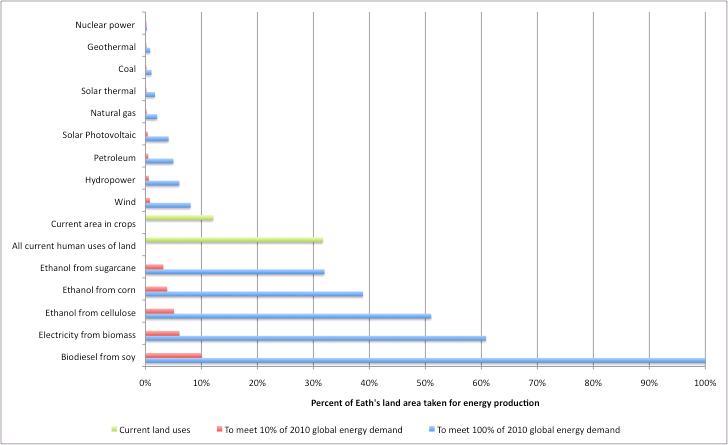
Your land-area charts mostly show that biofuels aren't viable. I don't disagree with that conclusion:
Note that the delta for nuclear and solar isn't particularly significant, again noting that solar power can be co-located with other land uses.
I'd also strongly suggest you actually read and view my references before responding, as several of these aspects are addressed. And you've wholly avoided addressing the large-scale, long-term, unavoidable systemic risks of nuclear.


UPower meets these by (1) being small enough to build a very tough, full scale emulator for testing, never before done in nuclear. (2) not competing on the grid, which gives immediate, in need customers which is also necessary for regulatory process to complete in (1). (3) using technologies and materials with decades of experience, in a new way, eliminating the huge uncertainties of many startups you see in the news.