A little off topic but wondering if anyone remembers keying in and debugging the "game of the month" featured in Antic magazine (Atari 800)? You you have to hand type and debug pages of line number basic and the games were largely simple sprite games.
My dad had an Atari 800XL, and typing in the games is what got me interested in development as I got older. Even in my early forties, typing in code from a book gives me more understanding than just reading code already handed to me.
I hand typed apps on other 80s home computers. Credit to anyone who managed it on an Atari 400 which probably had the worst keyboard this side of a ZX81.
There was one worse: the one that came with the BASIC on the Atari 2600. And this was actually my first "computer" on which I wrote BASIC programs: an ATARI 2600 console.
The BASIC cartridge was coming with some kind of keyboard controller that you'd plug in the 2600's joystick ports.
It was horrible but it allowed to do simple programs and even draw colored lines etc. IIRC.
I typed in pages of code for years, though mostly from Analog. At one point, they had pages of hex (or base36?) data lines and created a checksum process that would spit out the checksum after each line entry and you could check it against the magazine listing.
Basically, you were typing in ascii representation of machine code for pages on end for these assembly games.
This and GP: I do totally remember. Was a major pain but at the same time it felt like complete magic once you see the program running (even if, even for back then, it was often really bad). I didn't know how to program anything else than some BASIC yet, so it was a bit frustrating that these lines of data were just looking like random numbers, impossible for my 11 years old self to understand.
Now because I was a bit evil, when on summer camp (without my Atari 600 XL) I'd create small BASIC programs and mail them (snail mail, obviously) to my mom with accompanying instructions and SHE had to enter my program. Then I'd phone her and ask her what the program did : )
I remember my sibling and I would take turns typing up pages of code and fixing the bugs to play a game. And then at the end of the night lose it all because we had no disk storage and the parents needed the TV.
I remember trying. I think I even got one program typed all the way in. I spent months trying to get some adventure game typed in, but never got all the way to the end. Eventually I disccoered BBSes, which were great until I hit my download limit and I hadn't managed to download anything that wasn't already on all the other BBSes that I frequented and so I didn't get much that way. Eventually I found archives on the internet, but by then I had already moved onto BSD - I did something with emulators, but not much.
Compute! magazine had really cool stuff (really nice monitor/debug program for instance) in hexdump format with checksum bytes on the end. They had a custom program that let you enter the hex, then calculated the checksum and compared it to the check digits entered. Prevented a LOT of typos :-)
Yep. I learned to program on an Atari 400 using Antic and some other magazines. Gotta admit the amazement when I realized the power of changing a variable and it still working with new behavior.
The 800XL was a major price reduction from the original 800. In addition to manufacturing and component cost improvements, FCC regulations relaxed a bunch between the original revision and when the 800/600XL came out. So they were able to drop a boatload of RF shielding, just like the VIC-20 and C64 could. The inside of the original 800 looks like a bloody Faraday Cage.
And by that point in the 80s the original 1979 Atari 800 case design was starting to look really 70s. At least that's how it seemed to me as a kid. The 1200XL/800XL case looked so slick. It's up there with the Sinclair QL and some of the Japanese MSX machines in terms of case design, IMHO.
The 800XL is probably one of my favorite 8-bit computers aesthetically, and definitly my favorite amongst ones that I own(C64, CoCo2, Ti-99/4a), thought the Ti-99/4a is close second with that black and metal design, it's just missing some sleekness.
It is all about the nostalgia. I was introduced to this thing called "BASIC" on the 800XL and remember the joy of making the computer beep the theme from Close Encounters of the Third Kind.
For me it was an aesthetic thing. The black modern look with metallic buttons it had was a departure from the beige that dominated computers of the time. Atari had a great design sensibility. The Atari 5200 was another great example of slick design for the time.
the 800xl looked cool, 64k of memory and basically competed head on with c64 until the rise of the next gen Amiga/Atari ST, only to be obliterated by PCs once SVGA came along
From my understanding -- POKEY chips are easy to get because they were in so many things other than the home computers (arcade games, some cartridges, etc.). SALLY is easy to build a replacement board for using off the shelf logic and a stock 6502, so less of a complicated situation than the 6510 in the C64. So that leaves the two graphics chips (ANTIC and GTIA).
Not for long. Tramiel developed a very bad reputation for screwing over retailers, and his management style led to longer term problems once his family took over Atari Corp. And the terms "platforms" and "compatibility" meant nothing to Commodore in that era. Each machine they built was incompatible with the next, and the C64 was the only truly successful one.
The Pokey had/has its own charm. The SID is nice, but that's hardly what was selling C64s.
Anyways, you're right, pricing. My cousin had an 800XL and I had a VIC-20 and my neighbour a C64. Given a choice, I would have taken the 800XL; its specs were so much better in so many ways and damn that case design was nice. But that product line was always more expensive. If the original 400/800 had been cheaper, Atari would have owned the industry and something like the C64 never would have succeeded. From many points of view it is a superior platform (apart, from as you say, the SID).
According to Wikipedia:
"After losing $563 million in the first nine months of the year, Atari that month announced that prices would rise in January, stating that it "has no intention of participating in these suicidal price wars".[48] The 600XL and 800XL's prices in early 1984 were $50 higher than for the Commodore VIC-20 and 64,[49] and a rumor stated that the company planned to discontinue hardware and only sell software."
Warner Bros axed things and Tramiel picked up the corpse after he was pushed out of Commodore.
The Tramiels were notoriously tight with money, and would often just refuse to pay people when they thought they could get away with it.
We had some Vax 11/780s (for engineering and finance), and DEC's service technicians were instructed to collect a cashier's check at the door or walk away. I got handy with diagnostic software and a soldering iron.
In one incident, we had some Motorola VME/10 68K-based workstations that kept failing and needing things like motherboard replacements (they were not well designed). About a year after we pivoted development to the Atari STs (hey, dogfood...) Sam Tramiel asked me if we were still using the VME/10s.
"Hell no," I said, "They were pieces of junk. They're over there in a corner." I pointed to a corner where a couple of them were stacked up, gathering dust.
"Okay, we won't pay them, then," said Sam. He was grinning. I felt a little sick.
You really did not want Atari to owe you money, especially if you were a "little guy".
Those were just cross-development for non-GUI stuff (BIOS, drivers and languages). Folks doing graphics bringup were mostly working on Apple LISA systems booted into CP/M-68K (ugh), since they were similar to the ST with a monochrome monitor.
Not sure if you pay attention to this stuff, but some folks recently brought EmuTOS up on the Apple Lisa. This was after some people got original DR GEMDOS 68K/GEM to boot on it again. So, from software archeology to full circle.
Also in that picture RR-Net for instant loading of .prg and multiplayer. The Nunchuk64; an adapter for the new (S)NES Classic/Mini controllers:
It's some kind of revenge to play Super Mario Bros on the C64 with an original new NES controller from Nintendo!
I got the new transparent case too, waiting for the MechBoard64 keyboard and new Keycaps!
The VIC-2 chip also has it's upsides, even if the palette and 2-pixel-wide 4-color mode is weird; the community today is the most active and it's growing:
Maybe better ads? Maybe parents thought a computer from a "business machines" company was better than one from a video game company?
The 800XL OS and disk system were way better. The BASIC was better, though slower. The 800 keyboard is better than C64 which is slightly better than 800XL. The reason is that although the C64 keyboard is mushy, you can type faster on it for some reason.
Mix of price, compatibility, dev support. Atari was behaving like a consumer electronics company and left the developers starved for information on the computer, while Commodore shipped every unit with a very comprehensive manual. The C64 was a clean break from predecessors in most respects and the VIC II was more straightfoward to program for typical raster graphics(even if it missed some of the neat features of Antic and CTIA/GTIA), while the Atari had a legacy install base with lower memory capacity. So, by the mid 80's the Commodore had become the defacto cheap game machine, in absence of new console competition. It was never a great applications computer, in fact(I/O limits derived from the low cost architecture meant it did less than an Apple II for many development and business tasks) but it hit a certain sweet spot of being a great first computer.
Atari after the Warner acquisition was a hugely dysfunctional company - there are a lot of proposed alternate histories where different projects got prioritized and execution was better, that would have given them a stronger position in the computer market. As it is, they still put out some pretty cool hardware.
De Re Atari was published by Atari and was a treasure trove of detailed material. I remember buying it (as a pre-teen) and devouring it, trying to imagine “who thought of all this stuff?!”
It didn’t ship with every unit, but any dev could easily get one, given I was able to get one as just an interested kid.
I still remember the magic of writing HBlank interrupt routines to change player-missile positions and colors to “reuse” PMs to get more than 4+4
Atari eventually provided excellent support for 3rd party developers, but for the first few years they didn't support any kind of 3rd party development and kept the technical documentation under lock and key. Atari also didn't want to cannibalize their game console business, so they restricted the types of 1st party games they would develop for the system.
As a result, they squandered their significant head start in the game-focused home computer market.
I understand it's not possible to copyright a schematic in terms of connections between components, so this is a fair game to copy, but the PCB layout is protected as an artwork. I don't know how this one is similar to original, but I could imagine you would like to move things around. Or is it too old to be bothered by that?
Can't see the site because it's down but it's highly unlikely this remake uses all the same components in all the same packages as the original. The Atari 800XL would used entirely through hole components and its unlikely all the chips are still available in DIP. So there will at least be a little change to accommodate modern packages. ( I suspect)
I follow the vintage Mac community, and there are people there remaking classic Mac PCBs as drop-in replacements with the same chips since so many boards get eaten up by leaking PRAM batteries or old capacitors corroding the traces on the board. Most of the chips on the corroded board are still good (or at least the ones that are custom or no longer made) so you can desolder them from the dead donor board in the machine you bought and pop them in the new one


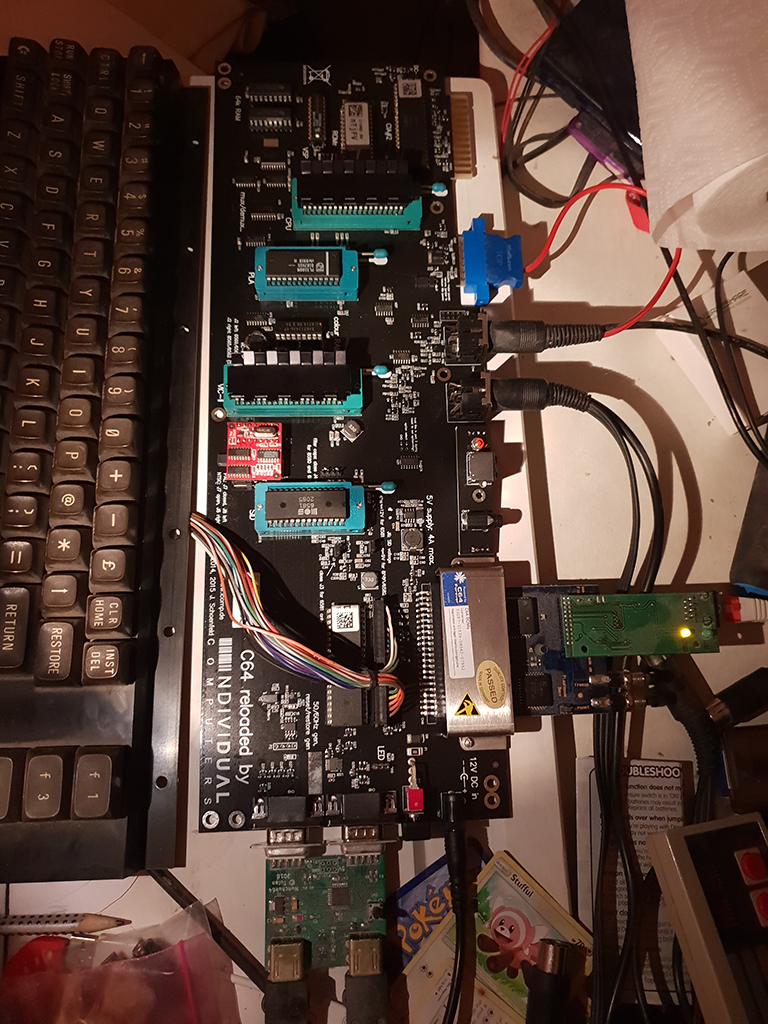
Amiga 2000 PCB remake: https://github.com/Floppie209/Amiga2000-remake
Amiga 1200 remake: https://wordpress.hertell.nu/?p=587
Amiga 500+ remake: https://github.com/SukkoPera/Raemixx500
Amiga 3000 AGA *(AA3000+) remake: https://eab.abime.net/showthread.php?t=97670
Commodore 64C remake: https://github.com/KicadRetroArchive/Commodore64C
Commodore 128CE (work in progress): https://github.com/jolsson68/C128CE
I'm sure I'm missing a bunch so please leave links to other retro computer PCB projects.