An oversight in the layout, in my mind—the human hand is better at typing in certain directions… the hands very naturally roll towards the center, but it is less natural to rotate away from the center. This is… somewhat covered in the article under SHU…
> It is much more efficient to ride the momentum of a single arm or wrist stroke and type a combo rather than just one key.
Try ASDF versus FDSA on a QWERTY layout. ASDF feels much more natural, doesn't it?
So, I’m concerned about the sequences like TH in the Workman layout. It looks like Workman is optimized more for minimum distance, and less for other factors. I think this is what happens when you optimize for the metrics that are easiest to measure! The thing about Dvorak is not just which keys press the fingers, but how you alternate.
So if you write THE on Dvorak, your right hand naturally rolls TH using strong fingers, and then you type E using the left. On Workman, you are rolling away from center, which is less natural.
Some clumsier words in Dvorak: SPHINX. PIX are all left 2nd digit, but they alternate with the right hand, to give the 2nd digit on the left time to move.
I may be biased. I switched to Dvorak in high school and it fixed my RSI. Dvorak is also available everywhere. I can sit down at an unfamiliar computer and change it to Dvorak within a minute. The alternation, to me, means that my fingers have more time to move and can move more slowly and gently at the same typing speed.
As a technical note—you should not be changing capslock in your layout like this on Linux. The option to choose a keyboard layout like US QWERTY or US Dvorak is a separate choice from the choice to map capslock to something else, and they shouldn't be combined.
I’m also a bit surprised that the bottom row is ZXMCV. This is so close to ZXCV… why not just use ZXCV?
That could be it. I'm also a piano player and I think inward finger rolls are overestimated on computer keyboards.
Dvorak also favours hand alternation, which I find appeals to me more. Unfortunately, Dvorak is not well suited to my native tongue (due to differences in letter frequencies) so I ended up learning Colemak instead, which also heavily emphasises inward finger rolls.
Weird. I think any stereotypical image of a person drumming on the table with boredom, their fingers roll from the pinkie to the index finger. Looking at gifs on Google Images, I couldn't find any going the other way.
That makes me think that an inward roll is much more natural. I can type ASDF almost as fast as I can type A by itself, quite literally. It's like a drumroll.
How do you usually get along in a professional setting with Dvorak? I use it too been using it for like 20 years now and it's very smooth but I'd be interested to know your impressions.
The only hiccup I encountered in the past several years is that I had to figure out how to set up my YubiKey. That, and video games use key labels too often, but that’s not a professional concern.
You had me with the FDSA example, but I wonder if that's because I'm also already biased towards Dvorak. Been typing with it since 2016 and loving it so far. Even "ls -l" doesn't bother me anymore - makes me wonder if QWERTY typists have under-developed pinky coordination.
After switching to Dvorak many years ago, I picked up the habits for a lot of shell commands to shift my right over two keys, so that my ring finger could hit the hyphen. `ls -l` is much more comfortable to type with middle-ring-middle than pinky-ring-pinky. I'm sure I've picked up other subtle shifts like that as well, and switching to a split layout keyboard also showed me just how much my hands crossed over for F, Y, and X.
I've been using workman for a few years now, and that hasn't bothered me at all.
I agree with not setting caps by default, since you can just use 'setxkbmap -o ctrl:no_caps'. I've been using a keyboardio model01 for the past year or so, and haven't bothered putting capslock into my firmware layout.
Having m between x and c did make learning more difficult, but I rather like it now that I am used to it.
I see no difference in rolling direction - both ASDF and FDSA feels uncomfortable. Try common words - FUEL vs THEN on Dvorak. Same for me.
I agree with metrics part - as a long time Dvorak user I feel article undervalues hand alternation and victimizes middle column. For me bottom row outer keys a weak part.


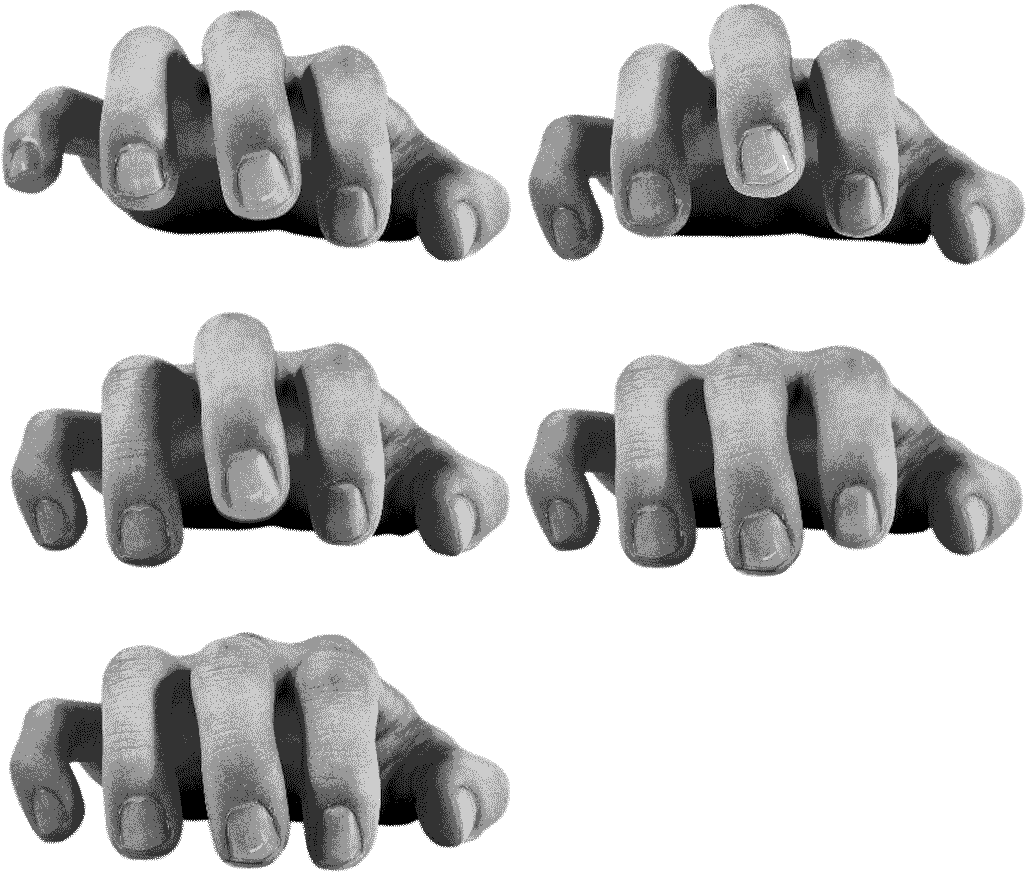


> It is much more efficient to ride the momentum of a single arm or wrist stroke and type a combo rather than just one key.
Try ASDF versus FDSA on a QWERTY layout. ASDF feels much more natural, doesn't it?
So, I’m concerned about the sequences like TH in the Workman layout. It looks like Workman is optimized more for minimum distance, and less for other factors. I think this is what happens when you optimize for the metrics that are easiest to measure! The thing about Dvorak is not just which keys press the fingers, but how you alternate.
So if you write THE on Dvorak, your right hand naturally rolls TH using strong fingers, and then you type E using the left. On Workman, you are rolling away from center, which is less natural.
Some clumsier words in Dvorak: SPHINX. PIX are all left 2nd digit, but they alternate with the right hand, to give the 2nd digit on the left time to move.
I may be biased. I switched to Dvorak in high school and it fixed my RSI. Dvorak is also available everywhere. I can sit down at an unfamiliar computer and change it to Dvorak within a minute. The alternation, to me, means that my fingers have more time to move and can move more slowly and gently at the same typing speed.
As a technical note—you should not be changing capslock in your layout like this on Linux. The option to choose a keyboard layout like US QWERTY or US Dvorak is a separate choice from the choice to map capslock to something else, and they shouldn't be combined.
I’m also a bit surprised that the bottom row is ZXMCV. This is so close to ZXCV… why not just use ZXCV?