I've been reading Tim Urban's writing for a while. One of the most valuable things in his writing isn't originality, but delivery.
He might not be coming up with original ideas (he regularly references the research he consulted to form his writing) but he _does_ do a great job of breaking down complex ideas into a form that's easily digestible.
The first several chapters of this series (worth a read, even if it's the only thing you read this year) are devoted entirely to building the vocabulary needed to discuss these concepts. He works hard to help build a mental model for the reader, which makes his writing significantly more accessible to the average human.
I think that breaking down the concepts is also helpful for Tim, as well as anyone who's trying to wrestle with complex ideas, in addition to the audience. Making sure your concepts are well-defined and clear is key to building them into something greater. So many flawed ideas are flawed because they're built off of a shaky foundation. Unfortunately analyzing those foundational ideas critically is difficult. I've found that writing essays helps force you into doing the hard work, but it's very time consuming.
It seems to me like most of the topics Tim covers are not very complex at all. His most famous articles are on procrastination, which pretty much everyone already understands. The main value was in adding characters that people could use to visualize the problem. Likewise, all the ideas presented in this series are either obvious (eg. US politics are very polarized these days) or dubious (eg. The rational mind is politically centrist).
He makes plenty of good points, but completely fails to make mention of how plurality voting (also known as "first past the post") results in two dominant parties, rather than electing people who represent the preference of the median voter. This is known as Duverger's Law, and I would argue it is about 90% responsible for everything he speaks of.
Voting systems that don't do this exist. Approval voting is one of the better ones (unfortunately, Ranked Choice voting doesn't do much at all to alleviate this). Approval voting has been enacted in Fargo, ND and is being considered for St. Louis, MO.
The charts he included show that there actually is a reasonable middle ground and lots of voters are there. The problem is that candidates that are in the middle can't get elected. Imagine how different things would be if our election system tended to elect the first choice of the median voter.
I'm a fan of single transferable voting, but the claim that FPTP is responsible for America's politics does not seem well borne out by the evidence. As the Wikipedia article on Duverger's Law notes: "In practice, most countries with plurality voting have more than two parties." The USA is very much an outlier here. Even if there remained only two _dominant_ parties, a significant third party like the NDP in Canada, or the Liberal Democrats in the UK, would reshape congressional politics very significantly.
I think the reason why US has two parties is that most States apply FPTP at a district level, but then also have a winner-takes-all at State level based on the districts result. So one district selects one party, and then the State gives all its N votes to the majority party among districts, selecting N people of the same party.
UK only has FPTP at constituency (district) level. So one constituency selects one person (one MP belonging to one party).
In UK when voting you have to chose among the top two parties in your own constituency in order to have a chance to get the MP you want rather than throwing your vote away. Votes distribution at national level doesn't really count from the voter point of view.
In US when voting you have to chose among the top two parties in your own State because if your district picks a third party and no other district does, your whole district vote is thrown away. Votes distribution at State level really counts from the voter point of view.
It isn't thrown away, though. If your district picks a third party, you send a third party representative to Congress. You'll have different choices in district-specific and state-wide races but you could also have a third party senate candidate and no realistic third party house candidates (for example Maine in 2018, though they had ranked choice voting). I don't see how having multiple levels of elections changes things beyond larger populations making it harder to coordinate outside the parties.
Without FPTP I think you would get more parties, and as you say these parties will influence the politics or introduce actual dialogue between parties in composing governments. Essentially all countries that I know of with a more proportional representation system have more parties and a less polarised political system.
I think the purpose of democracy should primarily be to avoid civil conflict and only secondarily be to represent the median voter. First past the post voting ensures a two-party system which means that people will make compromises while voting and not outsource that responsibility to politicians. The latter might cause voters to not own the consequences of trading favors (which is necessary for coalition building) and potentially lead to civil conflict.
I think representing the median voter is the best way to avoid conflict.
Imagine you have a shared workspace and people vote on the temperature to set the thermostat. Do you think he best way to avoid conflict is to have a system that encourages people to cluster into warm nature and cool nature people, one or the other get their way? Or is it best to simply settle on the median, which tends to be right in the middle and no one is miserable.
Thank you for introducing me to Duverger's Law! I had been looking for that concept for a long time but never knew how what it was called or how to search for it.
There are some interesting voting systems out there, including quadratic voting, that used market based mechanisms. Maybe something more useful would be something like a prediction market where people can pay to express a preference for a particular policy decision. Everyone would receive an amount of credits depending on the amount of property they own (not necessarily land, but some abstract notion of property).
I basically disagree with this formulation on the grounds that it does not sufficiently respect political opinions as being reflective of self-interest; these opinions are often a result of not just consistent messaging but tangible incentive.
It's much more straightforward to view the public politics and culture as a primarily top-down construction: "let's make these groups more upset at each other; let's make these other groups reconcile". This decision, made for cold reasons of accumulating power for oneself and immediate cronies by herding public opinion, subsequently filters down through the system via funding grants, access to information, and the occasional revolving-door or literal kickback. It gets amplified because job holders and job seekers spot the opportunities and threats awaiting them through a simple agreement or disagreement: they therefore start conducting themselves accordingly in "the way of the times", taking up the causes of the powerful with a bare minimum of overt messaging, hoping that they have backed a winning horse. This scramble happens across a broad range of industries, at many levels of the career ladder, and in seeking friends and relationships. There is a lot at stake in having "right opinions," in fact. The way in which the country seems to "come apart" or "come together" on issues is therefore most reflective of disagreements at the top, and produces a four-year cycle in a political-cultural feedback loop tied to electoral results: the politics become the culture, disseminate through media, and in turn inform the politics of the next cycle.
The wedge that breaks the cycle, on an individual, issue-by-issue level, is good storytelling. Stories have the power to change self-narrative towards a direction independent of the structural narrative, and their fulfillment generally comes with some way of overcoming structural forces.
But as for why there's the specific conflict we're experiencing today, it's pretty simple: it's a local vs global conflict; when you globalize, there are some "powerful losers" at the local level. And so the narrative has been a competition of these interests, proxied through various parties and institutions.
I don't think that most political questions pit people's actual self-interests against each other. The biggest exception of course are some policies like affirmative action where the lines of self-interest are obvious. But for many other issues e.g. drug policy and climate change there are a great deal of factual misconceptions driving policy by causing people to think their self-interests lie other than where they are. Engaging the rational mind is usually considered important in dealing with this situation because it does better with facts.
I have enjoyed WaitButWhy articles in the past but with this new series the author seems to have spent a huge amount of time, energy and words coming up with ideas that aren't that new. I keep skimming through them waiting to find the big point.
I think any one of the ideas in the ten chapters so far are probably largely "accepted" (or sometimes controversial, such as simplifying a person's thought process to Primitive vs Higher-minded.) But I think trying to put the pieces together is harder.
People are quick to say "polarization happened because..." or "people hate the opposite political party because..." or "people only read news they agree with because..." and each of the pieces might be useful but I think seeing how those pieces are fitting together and compounding is also useful.
None of this is new. At all. The echo chamber is just louder now. Plato and Aristotle were obsessed with this shit, and they are the two most widely-read voices from antiquity. This is literally the value of a "liberal arts education" (small l liberal unrelated to the right / left spectrum). Philosophers have been writing about this stuff in similar terms since writing was invented, and probably talking about it before that.
More modern philosophers have written more approachable versions, but the ideas are as old as we as a species can remember.
I think to gain anything from long form articles, you need to read and consider what's being written, rather than skimming, looking for the holy grail.
What the author says here is better said by a dozen others. I just had an overwhelming feeling of no shit sherlock when reading this -- yes, it's obvious our media is polarized, for obvious reasons.
I'm going to guess his next chapter is about how money ruined the media and politics, which is "why you shouldn't write about these things" -- because the people with the loudest voice have the most to gain from the polarization of the media. Again, this is pretty obvious. The loudest voice becomes the only one you hear in an echo chamber.
It was insightful the first time I read it from Socrates and Aristotle. But at this point it should be common knowledge for anyone interested in philosophy (literally: the study of knowledge).
I do. Get rid of First Past the Post voting and replace it with something like Approval voting.
As it is, candidates in the middle can't get elected. Two dominant parties is an entirely predictable result of FPTP voting. Approval voting (or ones that tend to elect the Condorcet winner, which also should be the first choice of the median voter) would solve 90% of the problems cited in this article.
I suspect that proportional representation is even more important to establishing a multiparty system that forces cooperation rather than polarization.
But that is a much more significant structural change.
And I'm not convinced "multiparty" is what we want. I think we'd be better off if parties had far less significance. Special interest groups? Sure, they'll exist. People who advocate for, say, bigger vs smaller government, more or less military action abroad, antitrust vs laissez faire, etc. But they don't have to nominate individual candidates...that's really only needed when you have a system that has vote splitting.
That would require an assumption that there is something that can be done. I'm not saying we all throw up our hands and die; but any attempt to fix the situation just adds another voice to the echo chamber and doesn't really solve the problem.
As far as I can tell from reading history, it's always been like this. We just haven't had a massive mutually-destructive war in anyone's lifetime to remind us why we should work together. Old soldiers are the best anti-war advocates there are. Because I'm pretty sure that's where all this is headed.
Indeed, looking back through history there's no shortage of reasons for pessimism - Mother Nature certainly left a lot of work for us to do ourselves. But if you're claiming that there isn't also plenty of reasons in history for optimism, you should maybe consider looking through a different lens.
At the risk of sounding glib, this style of thinking sounds a bit too much like the proverbial "we've tried nothing and we're all out of ideas!" I mean seriously, while lots of people are drawing attention to these old issues with a modern twist, has anything really been tried to fix them? Perhaps it's going to take some time to get our act together at the political level, but is there anything stopping communities like this from putting on our thinking caps and seeing if we can come up with some new and useful ideas?
I read a lot, but since there's always so much more to read than I could ever handle, I need some way of doing triage. I skim stuff to get a sense of if it's worthwhile. The claim that you have to read the whole thing in order to evaluate it reminds me of the claim by some religions that you can't refute them unless you've invested many years learning their sacred scriptures. It absolutely could be a true claim; it just isn't feasible.
I understand your perspective on it. But I don't think I'm claiming that you can't refute what's in the article, and you certainly don't have to read it all to refute something.
But bambataa did not refute anything from the article, just saying that it doesn't contain anything "big", without actually reading it. I think that's a fairly different situation than the one you used as a example.
It would more be equal to "You can't criticize religion if you haven't read anything about it", which I think it fine. You have to at least understand what you are critiquing, otherwise you're basing your arguments on something that you could have misunderstood.
In full agreement. I've never been a huge fan of the site, but the amount of time that went into this compared with the takeaways from reading it seems out of whack.
Many of these concepts are widely accepted, to the point that if you don't agree with them yet you never will.
It really grinds my gears that your opinion on a thing you didn't completely read is right next to well thought-out responses by people who bothered to read the article.
I read the first few chapters as they came out and didn’t think I learned anything new or saw new insights. I have been a bit cautious with how much time I invest in the subsequent chapters. Sorry to have upset you!
Maybe you're obviously not the target audience then.
Since you seem at a loss as to why this article is so successful -- maybe you should ask yourself what you're missing. It seems to me you haven't mastered the author's talent of addressing deep problems in an uplifting way that draws others in.
What is the point of this, other than to make snide comments and sling insults? In my experience, a person's ability to "address deep problems in an uplifting way that draws others in" is completely independent of their ability to read and think critically.
For example, do you have any suggestions on what the OP is missing, or could you explain why the article is "so successful" in your opinion?
Since I also didn't get why this article needs to exist (I can imagine how much time the author spent on it, only to present what to me are numerous well known issues and a couple unfounded assumptions), I would love to know what the OP and I are missing.
It's apparent you didn't understand what I wrote at all.
My point is (and I'll spell it out for you too, since I think it may apply) -- knowing the right thing is usually much much much much less important than being able to get other people to understand the right thing.
This article is good because it does the 2nd. There is no lack of unhappy people decrying problems, the world has no use for that.
The world does have use for people who can inspire differently-minded people to focus on (and find joy in) fixing a common challenge.
> It's apparent you didn't understand what I wrote at all.
It's hard to say. I told you what it seemed like you wrote and explicitly asked what the point was, hoping there was more to it than just an series of insults.
You responded with this seemingly independent comment, which is fine, but very different in content than your initial comment. Because of that, it's not surprising that I would have missed the point of your initial comment if in fact both of these comments are attempting to convey the same information.
> My point is (and I'll spell it out for you too, since I think it may apply) -- knowing the right thing is usually much much much much less important than being able to get other people to understand the right thing.
In my opinion, it depends.
Getting people to understand what you're saying when you're wrong isn't helpful at all.
If you do have something original and helpful to say, it is important to convey that information in a manner that others understand.
If you're saying something everyone in your audience already knows, it doesn't matter if you're personally understood or not, because the position is understood by default.
Unfortunately, I put this article in the last category. I am legitimately questioning whether I learned a single new thing of value from reading that entire article, and questioning whether anyone in the audience of that author wouldn't already know this information.
> This article is good because it does the 2nd.
In case it isn't obvious already, we disagree here. I don't think it gets people to understand much of anything, because I don't see any point to the article (which I read in its entirety for the record). To me, it's a compilation of generally well known issues, personal anecdotes ranging from amusing to distracting, and theories that don't seem to have much backing them up. I ended the article wondering why the author (who I respect) spent so much time and effort compiling commonly known information that has been repeatedly analyzed and presented elsewhere, and when (if ever) there would be a point to this series of articles.
You've stated twice now that this is a great article. I'm asking you why you feel it gets people to "understand the right thing", because it didn't have that effect on me.
> There is no lack of unhappy people decrying problems, the world has no use for that.
I'm not sure if I agree with that, and I'm not sure what use there is for extremely long-winded descriptions of the status quo.
> The world does have use for people who can inspire differently-minded people to focus on (and find joy in) fixing a common challenge.
The lack of a "call to action" of some sort does seem suspiciously absent.
The best parts I could find that addresses this are in the conclusion...
> Maybe instead of focusing on how politically active the most extreme people are, we should be asking ourselves why those who hold “more complex views” have become so inactive.
This seems like a very good question. To me, the article pointed out plenty of reasons for serious concern about the way the winds are currently blowing, yet in my experience the typical response to this perspective is a collective yawn. Perhaps the author takes it too much for for granted that readers will intuitively recognize the risks that come along with this sort of climate, or maybe he's still just laying ground for something to come later.
> When I told people I was planning to write a post about society, and the way people are acting, and the way the media is acting, and the way the government is acting, and the way everyone else is acting, people kept saying the same thing to me: Don’t do it. Don’t touch it. Write about something else. Anything else. It’s just not worth it. It hit me that what I really needed to write about was that—about why it’s perilous to write about society.
This also seems interesting, and seems consistent with my observations. People of all political stripes seem to absolutely love anything that gives reasons to hate on their respective out-group, but any suggestion that there's plenty of guilt to go around seems to get a much chillier reception. Of course, "everyone knows this" - but how many of those who "know this" also have the ability to detect this behavior in themselves, in real-time, when the topic is not the abstract nature of this human behavior (as in this thread), but rather an object level discussion about a specific culture-war matter? Next time you encounter such a thread on HN, pay attention for the behaviors described by the author, and judge for yourself.
> It hit me that what I really needed to write about was that—about why it’s perilous to write about society. I ended up going with some combination of both of these things: society’s current situation and why it’s an especially bad idea for me to write about it—and how those two things are related. This chapter focused on the first item: society’s current situation. But the second item—about how incredibly ill-advised it currently is to write about that situation—is the item we need to look hardest at. That’s where we’ll go in the penultimate chapter of The Story of Us.
It sounds like he has more to say on the matter, hopefully future installments get more into ideas of what people can do at the individual level.
This is a long and interesting article that, because it is attempting to preserve the system, ultimately misses the mark:
My obsession over the past three years has been trying to figure out how our national immune system works, where it draws its strength from, and how we can get it working again.
There is no national immune system because there is no nation. The US has never been a nation. It was a loose amalgamation of many nations on a huge continent under a commercial republic, then a warring set of nations, then an oligarchic industrial powerhouse that finally matured into a financial/military empire. All of the internal conflict we see benefits the ruling class and, therefore, will continue and, in all likelihood, get worse.
Much to be made about Zizek's observation that there are false characterizations of the problems of a situation emerging from those same situations. Proposals are made to solve the problems that society faces, which are broadly in agreement with the systems that produce the perceived problems, so rather than retarding societies progress toward a certain predicted endpoint, it actually gets society to where it was already going, quicker.
> I recently engaged in a fun, joint Psych Spectrum roller coaster with a stranger on an airplane. We were on the runway, getting ready to take off, and I was doing my typical “I know the flight attendant said to turn all phones onto airplane mode but the whole policy is really quite inane so I’m just gonna keep texting until we take off and I lose service” thing, and a woman next to me decided I was an asshole and loudly told on me to the flight attendant, who was busy and didn’t hear her. So I did the only reasonable thing—I stealthily turned my phone onto airplane mode, re-opened my texts, and very out in the open, started typing a long text. The woman—my new eternal arch-nemesis—took the bait. She saw me texting and again got the flight attendant’s attention, saying, “Excuse me but he’s still texting.” When the flight attendant asked me to turn airplane mode on, I showed her my phone and calmly explained that airplane mode has been on this whole time and I just like to get some texting out of the way during flights—texts that don’t send until I land and re-connect to the internet. The flight attendant said, “Oh then that’s totally fine—my apologies.” I replied, “that’s okay,” and did a little “it’s amazing how awful people can be right?” sigh. Satan watched the whole thing and then just sat there silently, hopefully very embarrassed. It was an unbelievably satisfying, triumphant moment.
Not the main point of the article obviously but man, the writer makes himself sound like a bit of an asshole with this story. Didn't encourage me to listen to his other opinions.
Edit: I kinda regret making this comment since I think it detracts from discussion of the article itself, which is very thorough and thoughtful in general. Maybe this is a meta Psych Spectrum commentary.
“But that’s not what happened, because her aggressive tattletale move immediately threw my Primitive Mind into a rage, plummeting me down the Psych Spectrum. This banished my Higher Mind to the closet of my subconscious, allowing my Primitive Mind to come up with a genius-yet-psychotic plan for revenge. Which worked, and made my Primitive Mind feel deeply satisfied in a very not-grown-up way.”
His entire point is that the average person acts like an asshole some of the time and like a kind person some of the time, and that it is incredibly easy to cherry-pick examples to paint someone in a bad (or good) light.
Which is exactly what you have done here, proving his point!
I'd like to think most people would act more civilized initially in that situation. In fact the most civilized thing to do would have been to simply follow the rules in the first place, knowing that most passengers will believe they must be important.
I think that's his point. The jerk can be him. It can be you. It can be me. We are all of us able to be like this, able to be controlled by the "primitive mind", able to engage in power games.
And I differ a bit with your reasoning. Follow the rules because most passengers believe they must be important? Not because, say, the airline thinks they must be important?
For sure, everyone likes to think themselves and most people act decently 100% of the time and never irrationally. But then sometimes, everyone acts irrationally, for one reason or another.
Because it's likely to cause discomfort and negative attention from the other passengers who will worry it could jeopardize their flight, and not using your phone for a little while isn't a big deal. It's not so much about following a rule or not, as just being socially responsible.
I agree, if it actually mattered then flight attendants would check for cell connections as rigorously as they do seatbelts. Even if you've never flown basic logic will tell you on a flight of 100+ people not everyone remembered to switch off their device. Trying to rat on your fellow passenger is the real offense here. Maybe I'm the jerk here but do we have to regulate our behavior to make nosy neighbors comfortable?
The argument goes that you have to regulate your behavior to assuage someone else's feelings, for the sake of getting along. This is a very good thing to do in many cases but the same argument still gets used even when other people's feelings are completely irrational. Why can't we sometimes just tell other people to get a handle on their feelings so as not to impose unnecessarily on my behavior?
At some point we have to put a cap on how much we value other people's feelings. There are neurotic personality types that by nature literally make up asinine things to worry about, and you'd have to run an infinite treadmill conforming to their nonsense. Empathy is an important value but its not an idol to be worshipped, and it should not be a rhetorical superweapon.
I knew someone would disagree, but it just sounds really antisocial to me. Sure, the woman should have asked him to put his phone in airplane mode instead of going straight to the attendant, but he could have also replied with an "oh, sorry" and put his phone on airplane mode when told off about the rule he was in fact breaking.
Very well written piece, lots of supporting data. However- it bears pointing out the focusing on norms and compromise and mutual understanding is a squarely liberal stance. Remember the John Stewart “Rally to Restore Sanity” which basically made the same points as the article. And unfortunately, Obama discovered that the political right was decidedly unwilling to reciprocate any sort of offers to compromise. So it seems that unless both sides are ready to back down, we are stuck where we are.
There's a branch of analyzing US politics through the lens of "primitive" and "civilized" brains that stems from Haidt's old ideas ("elephant and the rider"), which I still to this day do not find compelling.
If part of my culture's routine every day is kicking a kitten and my society near-violently disagrees whether it should be 2 kittens per day or just 1, and instead of comparing cultural notes with the 10k+ other cultures of the world (to realize this isn't normal) I spend time talking about human brain hacks which preserves the hideous self-righteousness of my ego and my culture of kicking kittens, then I've effectively absolved myself from personal responsibility like a good Kantian ethicist and can keep kicking kittens without remorse (and, not hold anyone else accountable for kicking kittens) because "My selfish lack of critical thought is forgiven because my brain is just wired to be hacked that way, same for my peers and their brains".
Take responsibility for how you use your brain and what you expose it to, and do the same to your peers. You are so much more than just a brain being hacked upon.
I skimmed this, and there's some good and interesting data and analysis here. The one aspect that seems to be missing, by its own admission, is how this fits in with the rest of the world. This is looking at the USA in a vacuum, which is not without merit, but countries no longer exist in a vacuum, especially the USA.
As mentioned in one of the last "Fun and Procrastinatey" footnotes:
> The U.S. Left has moved enough that it now matches Europe’s leftness. The U.S. right remains further right of most of the European Right.
Viewed globally, according to this link, the US Democratic Party only crossed to the Left of the median party in the past 5 years. There are very few parties in the world as far Right as the US Republican Party.
This article sounds like it's trying very hard to stay neutral and simply point out the increased polarization. Left and Right are Blue and Red, and are only compared to each other. It neglects to show full context: that US Left is actually Middle, and US Right is actually Far Right.
> It neglects to show full context: that US Left is actually Middle
The US Left is Left, but the US has three big factions: a very large Right faction and smaller Center and Left factions, and he Democratic Party is an uneasy Center-and-Left coalition, where the Center faction has been dominant for the last couple decades but has lost some ground in the last few years to the resurgent Left.
I haven't read the series but it seems that political polarization is the topic.
This is perhaps the biggest mystery I'm aware of in the world today, especially because it's not specific to America, I'm seeing the same trends in my country as well:
- Extreme polarization along similar axes (conservative/liberal, urban/rural, age, ...).
- Outright hatred of traditional political parties.
- Rise of populist and non-traditional politicans.
- Distrust of traditional media, rise of low quality media (fake news in the extreme).
There's surprisingly little discussion and research about the cause of this. One interesting theory I recently came across is that the driver is the process of people moving from rural to urban areas. People who make such move are demographically distinct - more liberal for example. So over time this has cumulative effect and leads to increasingly distinct demographies.
Seriously? As someone in a rural area who is not particularly deficient in intelligence, who regularly keeps up with research and innovations in a variety of industries, who bootstrapped my own consulting business & hired two more employees this year, and who regularly deals with the mess created by a regulatory situation where policy makers and voters in CA forget there are a lot of very rural areas in this state and that a one-size-fits all approach is actually crippling to people outside of the bay area and LA: NO. You cannot say that.
And even being so willing to jokingly suggest it is an enormous part of the rural/urban political divide. I'm frankly pretty incredulous to see you do that in a post noting this very issue. The reality is, and I understand that this seems like a hard pill to swallow for the urban elite, different people in different places have different needs and issues.
That said, prior to your dig on rural people, I agree with everything else you said, and I find the trend deeply troubling.
> Seriously? As someone in a rural area who is [...] NO. You cannot say that.
Sure but you're just one person out of millions. We're trying to compare populations. And obviously the prior poster didn't mean that every rural person who moves to a city is more intelligent/ambitious than every person who stays, but you knew that already (note how you didn't object to more liberal, presumably because it doesn't carry a value judgment with it and also because it's clearly true in an important sense).
I haven't seen any studies, but it is very plausible to me that people who up and leave tend to be more intelligent and ambitious, if only because it's a costly thing to do and income/wealth correlates with everything good.
I think the definition of "intelligent" and "ambitious" will differ based on who you ask. A lot of folks in rural areas think taking out debt to go to school is not a very intelligent thing to do. Likewise a lot of urban dwellers would likely say that going to college is the intelligent and ambitious thing to do.
It really depends on your previously-held beliefs, which are only reinforced by the echo chambers we live in.
My argument that leaving your home town is costly stands regardless of what your definitions are. For a similar example, tall people tend to both be more intelligent and to come from richer families because malnutrition as a child negatively effects both height and intelligence.
You may ask if I'm not using a pedantic, irrelevant definition of correlation that captures even tiny correlations we don't care about, but when we're talking about politics (where swings of a few percent can reliably flip elections), and polarisation (which is pretty much defined to be the amplifying of small differences), I think this is very relevant.
I'd add to your list the increasing disconnect between wealth and quality of life. Economists and politicians will tell us how much richer we've become, how much our GDP has grown, etc, but so much of that "wealth" is that we have ipads and flat screen TV's. The things we actually need for a better life like housing security, social opportunities and stability are getting more and more out of reach. I think this is the main driver of populist politicians, they've tapped into this growing discontent quite literally because being content is getting harder.
here are a couple of interlocking potential causes: diminishing job security and social mobility for nearly half a century creating a general sense that ordinary peoples lives by and large are not getting better; political cultures isolating themselves in increasingly frantic and hyperbolic media bubbles, and escalating feedback loops of political signaling inside those groups; general distrust of social elites for failure to maintain or fix the system; elite overproduction incentivizing people who under different circumstances may have worked their way up traditional institutions to defect to alternatives and attack the old ones; proliferation of technologies of social influence and control. we're in for an interesting century for sure.
These are very long articles, and this is long chapter number ten out of twelve. So it's hard to TL;DR with any respect to a series of articles that's trying to TL;DR sociology, politics and polarization over the last half century.
The gist is that we have internal struggles between survival through power compared to thriving through critical thinking. This struggle is affected by the people around us; amplified because being part of a group pulls us in some ways towards survival instincts, and if we're lucky also pulls us towards critical thinking. As groups, we kind of have the same collective struggles as well.
The latest article uses ideas and terminology from the previous nine articles that I've attempted to summarize in a tiny paragraph above. It goes into some depth explaining how our country has slid, politically, from critical thinking and having opinions slightly one way or the other off from center (a center that has shifted over time) to having opinions grouped much further apart. Aka polarization.
And I'm not even done reading it. I enjoy it, and I'm optimistic models like this can help us, but I know that some people believe the models cut too many things out. I think that's problematic, because it is a very complex issue with a multitude of variables, and I think simplified models (and terminology) are necessary to explore the ultimate problem and potential solutions.
TL;DR: political polarization in the USA has measurably increased, and this is bad for the country and its citizens.
However, some data suggest that that two-thirds of Americans fall into what they call the "Exhausted Majority", people who are fed up with both major parties, and politics in general.
Especially since we live in an oligarchy but everyone still thinks in terms of red vs blue or us vs them. It is quite the trick to misdirect blame to people who are just like you.
To be fair thinking people "just like you" neccesarily have your interests in mind is also a dangerous and potentially fatal mistake itself, those trying to convince you are potentially engaging in misdirection themselves. Just because others are like you doesn't mean they won't also screw you over whenever convenient. Nor do differences guarantee that they will be bad. There are no guarantees, period.
> There's nothing polarizing or extreme about noticing oligarchy.
See, you and snarf21 keep assuming that we live in an oligarchy (perhaps snarf21 more strongly than you). You keep assuming that everyone can see that. Not only can't I see it, I'm pretty sure you're wrong. And I suspect that, if you polled HN, you'd find that about 80% of people believe that we do not actually live in an oligarchy (all numbers made up on the spot with zero statistical evidence). I refuse to allow you to just assume oligarchy as "everyone knows, everyone can see". You don't get to assume it; you have to prove it.
The reason I said snarf21's remark was polarizing is because, in terms of conventional left-right divisions, the claim that we live in an oligarchy is almost exclusively a claim of the far left.
(Disclaimer: When I claim that we do not, in fact, live in an oligarchy, I am not claiming that the rich don't have too much influence - just that they don't have enough power to qualify as an actual oligarchy.)
Which is it? Do the bastards "have too much influence" or don't they? Not all elections are decided by massive campaign contributions from the wealthy, but lots of them are. We haven't bombed or sanctioned every nation populated by brown people, but we've bombed or sanctioned lots of them. Real wages haven't been stagnant forever, but they have been stagnant since 1973.
If you want to draw a line just this side of "oligarchy" and say we aren't there yet, you can, but you've got to admit that trends are pointing in that direction...
Let's ignore all that. ISTM you've made a basic logical error. The topic ITT is "polarization", which is considered a bad thing. GP suggested a way to reduce polarization, by realizing our true interests. How could it be polarizing to suggest a way to reduce polarization?
The definition of oligarchy (I looked it up) is "rule by the few". Not "the rich", but "the few". So: Are we ruled by the few? Not "do they have outsized influence", but "are we ruled" by the few?
I would say no.
If you think we are, then do you think that Warren's tax on the rich is just a smokescreen that those in control are putting forth to hide that they are in control? Or do you think that Warren will not be allowed to win? Or do you think that, if she wins, she will never actually do what she says she's going to do? Or do you think that the tax on the rich is really what the few want to do? (At that point, your hypothesis is unfalsifiable, because anything that happens is what the few wanted to happen.)
Any analysis that relies on Warren will be "unfalsifiable". We don't have to watch the news much to realize that they're not afraid of Warren. Is that because they think she's fibbing about how she's going to crack down on the 1%? Maybe that's part of it, but the bigger factor is that they know Trump won't lose to "Pocahontas". The coverage she gets is very different than what e.g. Sanders or Gabbard get, because they're real in a way that neither Trump nor any opponent he has faced has been.
(Your back-and-forth about "few" vs "some" vs "1%" or whatever just proves the point about oligarchy.)
> (Your back-and-forth about "few" vs "some" vs "1%" or whatever just proves the point about oligarchy.)
I don't think that it proves any such thing, except apparently in your mind. Nor do I think that I was going "back and forth" between "the few" and "some". The 1%, perhaps, if you accept Warren's plan as targeting them.
By the way, this oligarchy that you think rule - are they more or fewer than the 1%?
I think that your point about Sanders is rather a large concession on your part. You seem to be saying that "the oligarchy" are concerned that Sanders might win, and therefore are orchestrating press coverage against him. But if they are concerned that he might win, then they clearly don't rule. Otherwise, they would have no such concern.
Well, they haven't assassinated him yet... you seem sort of eager to shit on my hope. The last three presidents ran for office promising no more stupid foreign wars. Are you trying to force me to admit that democracy in USA is a sham?
[EDIT:] Sorry, it's clear to me now that this is what you intended with your whole "how few is few?" routine. Clearly you don't consider it "oligarchy" when 51% of votes are used as toilet paper.
I deny you the right to put words in my mouth. Please stop misrepresenting my position and my words, trying to make it sound like they support your ideas. They don't.
One imagines wise boomers carefully examining the intricately arranged series of "Media Matrices" and sagely nodding at the subtle points illuminated in each. "Yes, I've heard of this 'Onion'; really not a very useful source of news!" "I wonder why they didn't draw the firm who employ my favorite news personalities here in this 'North Star' area?"
Do we really think the main problem in USA is that not enough people consume median journalism? This veers dangerously close to an assumption that our only real problem is that the "Fairness Doctrine" no longer protects us from Badthink. I'd propose a different idea. If there are actual problems of long standing, e.g. myriad interminable wars or shocking incarceration rates, they might owe their durability to the fact that few people really oppose them as hard as some other aspects of modern life are opposed. What sort of coverage would we predict of these problems from "the North Star"? Might that segment of the "matrix" elide such coverage altogether? When we do hear opposition to or even coverage of morewaralwaysmorewar or similar issues, and it comes from kooks like TheNation or ZeroHedge, does that reinforce the marginal importance of these issues, or perhaps does it call into question this matrix picture altogether? What was the point of the internet, if we all ought to watch the same news?
This article was highly disappointing to read. No mention of how Conservatism is effectively dead in the US (Donald “Bibi” Trump is basically a Democrat). No discussion of Federal Reserve and how it’s contributing to inflation. The author also seems to be a textbook narcissist given his overreaction to being told to shut his phone off on a plane. The only thing “Giant” about this article is this dude’s ego.
The liberal worldview thinks that everything is basically ok and that the problem is that "norms" are being violated and bad information leads to pointless conflict.
Liberals are wrong. There are fundemental structural problems with this country and the current psychosis is the result of neither political party addressing them while going war and profit crazy on the backs of the working people that slave and die without improving their position.
The comment is not fitting to the article, but I wanted to respond to it anyways because I found it interesting and it's not something talked about here much, for obvious reasons.
The problem is going to escape many on the left, including most people here as well, as many people here are mostly agnostic/atheistic/anti-faith and believe having faith is somehow anti-intellectual. The reality of the situation is the US was founded, both socially and politically on Judeo-Christian principles of morality, and the nuclear family and it is undeniable the evidence to support this in our laws and constitution.
We have seen more upheaval and social change in the last 10-15 years than the previous 50 all in the name of "progress" (never mind it is those very people who subscribe to that "progress" that are leading the way in unhappiness, depression, low marriage rate, low birth rate, and suicide).
There are positions now being held by major political frontrunners that are simply not compatible with any person of faith, or any sort of compromise with the opposite political party. There is simply no compromise to be had. The biggest elephant in the room is abortion. My two favorite writers on this subject are Caitlin Flanagan for a left-side perspective, and Alexandra Descantis for a right-side perspective. Both write very thoughtfully on this issue: https://www.washingtonpost.com/outlook/how-democrats-purged-...https://www.realclearpolitics.com/2019/11/16/an_honest_abort...
Many people call America a Christian nation. I know this will get downvoted to hell here. I consider myself a well traveled man, and I will quote one famous professor I had the pleasure of listening to a lecture of that rings especially true to me: "The only country in the world that doesn't know America is a Christian nation is America."
I have no more interest in religious authoritarianism than I do with "progressive" authoritarianism. Fundamentally, its the same problem from a different direction. If your faith (religious, political, vim/emacs, whatever) requires me to do something, things aren't off to a great start.
Authoritarianism leads to tyranny, and it doesn't particularly matter who's boot is on your neck in the end.
The backbone of the USA in its formative years was slavery and outright slaughter of native Americans. By people who went to church.
This dark legacy stretches into today - the last lynching was in 1981, and white Christian America still worships a vision of a nice, pearly white European looking Jesus, presented by millionaire preachers in mega churches who say “just give me some money and you too can be redeemed”.
And not to mention their pseudo worship of a man who is so laughably espouses the exact opposite of the Christian teachings. A man who had sex with a pornstar while his second (or third?) wife was pregnant at home and has never read the Bible.
I’d appreciate knowing how you can reconcile thinking what you commented with what actually happened, and how you can view a system of oppression, control and political propaganda (USA’s brand of “Christianity”) as anything but that.
> The backbone of the USA in its formative years was slavery and outright slaughter of native Americans.
Actually, most founding states sought to abolish slavery when the Constitution was being drafted. The Southern States were vehemently opposed to such action to the point that they would not ratify the Constitution. As a compromise, slavery was allowed, and no law could be made restricting the importation of slaves until 1808.
Consider, though, that the importation of slaves was banned on the first day which was legally allowed.
I think your problem is that what you refer to as "the USA" is really "the South." The South fought hard for slavery because of economics; slaves were cheap, and plantation owners were powerful. My view is that the powerful Southerners who benefited from slavery created a cult which poisoned the minds of other Southerners into believing that slaves were necessary. It takes a long time to erase all that.
> the last lynching was in 1981
And a school district in Alabama was ordered to desegregate less than ten years ago. What's your point? These are outliers. They don't represent the majority view. You're cherrypicking to make things seem worse, which is exactly what the post discusses.
> white Christian America still worships a vision of a nice, pearly white European looking Jesus
Consider that the book (and movie) "The Shack" portrays the three parts of God as an African-American woman, a Middle-Eastern carpenter, and an Asian woman as the Father, Son, and Holy Spirit, respectively. "White Christian America" still ate it up. But, according to your logic, they never could have because Jesus wasn't presented as white. Perhaps your viewpoint isn't actually correct here.
> And not to mention their pseudo worship of a man who is so laughably espouses the exact opposite of the Christian teachings. A man who had sex with a pornstar while his second (or third?) wife was pregnant at home and has never read the Bible.
Should a Muslim hate Trump? Should a Jew? Should he only be loved by athiests? What are you saying? People are far more than their religions.
I am close to someone who does things I could and will not do in my regular course of life. I see their lifestyle as degenerative and a coping mechanism, and that's my damn right. Yet, I still bought them a book on their least-harmful hobby.
People can still care and want to see others do well for themselves while recognizing the limits of their ability to affect change. Should we hope that Trump is a failure? That's like hoping for the bus driver you hate to crash into a tree; if that happens, you're gonna get hurt as well.
Maybe those people just see the world from a different perspective than you. It sounds like you're pretty "woke," but have you ever had a kind, thoughtful conversation to genuinely understand their point of view? By mocking them in this way, you're invalidating their opinion. But wait, isn't the left tolerant...
> Consider, though, that the importation of slaves was banned on the first day which was legally allowed.
None of this counters my original point. Cotton was an utterly crucial crop in the USA's development, and the total value of all slaves was 48 times the expenditure of the federal government, and 7 times the total value of _all_ the currency in circulation at the time (1860). I'd call that a pretty important backbone, even if it was localized to mainly the south.
> And a school district in Alabama was ordered to desegregate less than ten years ago. What's your point?
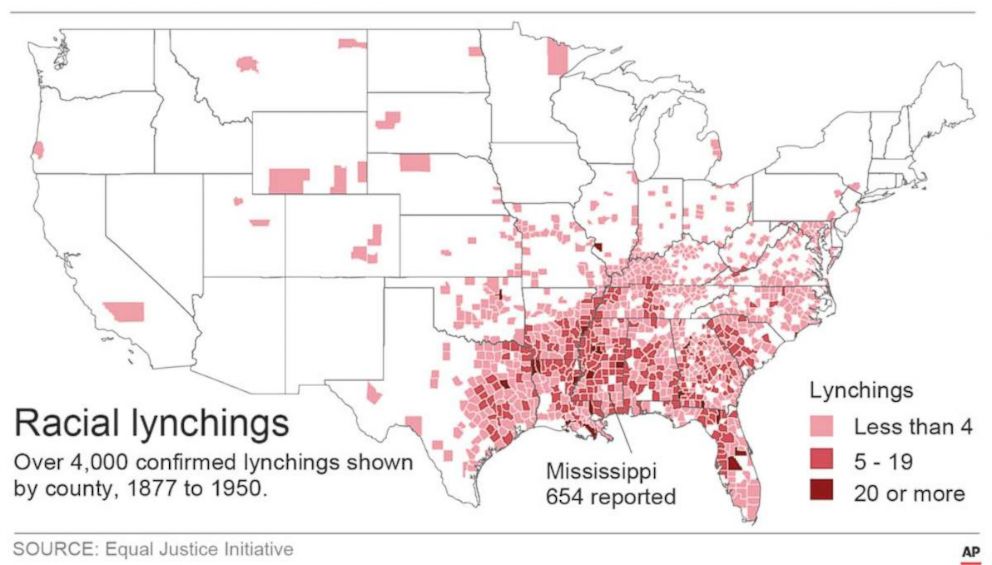
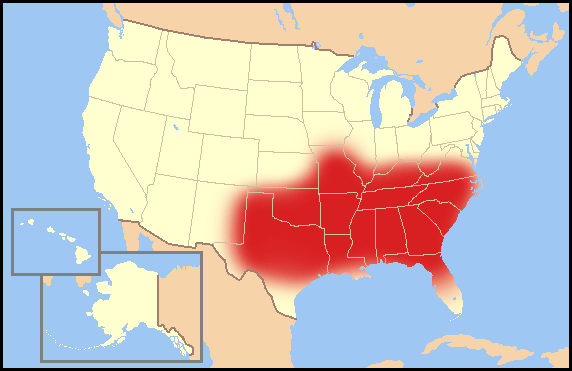
My point is that the last lynching was in 1981. That's utterly ridiculous. It only trailed off in the 1950's. Also here's a map of the lynchings[1], see a pattern? Maybe if you overlay a map of the bible belt[2] it becomes clearer. Love thy neighbour, right?
> Consider that the book (and movie) "The Shack" portrays the three parts of God as an African-American woman, a Middle-Eastern carpenter, and an Asian woman as the Father, Son, and Holy Spirit, respectively. "White Christian America" still ate it up.
To quote you: What's your point? These are outliers. They don't represent the majority view. Maybe they ate it up because it was "wacky" to see a brown Jesus on screen. Only on screen mind you, I don't expect many of them would want that imagery taught in churches! God forbid.
> Maybe those people just see the world from a different perspective than you.
Yeah, I expect their tax-excempt churches had a pretty fair and balanced discussion about both sides. No wait, riling people up about abortion then using that as a device to get people to vote your party into power, so you and your tax-excempt gravy train can continue to benefit is far too much of a good thing to risk. Especially by discussing how we can adapt society for the future rather than harking back to the good, clean family-friendly past (lynchings or not).
Everything is about control. Some people form opinions from TV, some from church. Just because a man stands at a pulpit doesn't make his words any different from a news anchor behind a desk. It's just unfortunate for their followers that they support such a regressive party. And as certain segments of the population age out and Christianity continues to shrink you'll see them ratchet up the furor to stay in control. Control people like you.
But hey, hold your nose and vote for the candidate that was sent from god[3], right?
> I'd call [slavery] a pretty important backbone, even if it was localized to mainly the south.
The localization of the issue to the South is incredibly important to consider, though. They actually seceded and became a different country for around four years because they felt slavery was that important to their economy. And, as another poster mentioned, the South (primarily agrarian) was much poorer than the North (manufacturing and agrarian) and had staggering levels of inequality compared to the North.
You say it's a "dark legacy," but what do you want to do about it? Crap all over the country for something which was last actively practiced 150 years ago? My ancestors were still poor farmers in Hungary at that point; they didn't have anything to do with slavery in the US. Slavery is awful and unjust, but don't expect me to hate others today for the injustices of the past.
> My point is that the last lynching was in 1981. That's utterly ridiculous. It only trailed off in the 1950's.
Racism is learned and taught. During the Reconstruction, the South reinvented their economy and culture, since slavery was dead and the white Southerners had to live near the newly-freed black Southerners. Unfortunately, that reinvention of culture included the significant perpetuation of racism.
It takes a long time to erase all that. Unless they're willing to sit and reason, there's nothing you can do. We can, however, raise our kids right so, with time, the racists will die off.
> Only on screen mind you, I don't expect many of them would want that imagery taught in churches!
Have you ever been to a majority-white Christian church in America? What about a majority-black Christian church in America? They all sing, pray, and listen. There's no discussion of Jesus' skin color, because that's not why they go to church. They go because they want salvation.
> riling people up about abortion then using that as a device to get people to vote your party into power
> you and your tax-excempt gravy train
> good, clean family-friendly past (lynchings or not)
Ok, it's clear you're hateful toward Christians. But are you really hateful toward all of them?
Yes, it's possible for a liberal Lutheran to exist. Do you still hate them? Would they hate you?
You lump white Christians together as some massive homogeneous blob, but you just can't do that because it's not fair. Also, do you think all sermons are just political rants? I can tell you they absolutely aren't. In fact, many people will go to church to get away from politics.
> There are positions now being held by major political front-runners that are simply not compatible with any person of faith, or any sort of compromise with the opposite political party.
And the political front-runners on the conservative front have given up on having a position that's compatible with those who live outside of faith. Those who reject the idea that an abortion should _ever_ be performed, those who advocate or even demand for re-implantation of ectopic pregnancies, despite doing so would kill the patient.
How, as a moderate, am I supposed to take those with such outlandish views as anything other than a rallying cry for further radicalization?
As for the rhetoric about what faith our nation should have or was founded on, I think if you're going to advocate our nation have a single faith you might want to further consider the founding father's original intentions, and the intentions of those in the 50s who chose (in fear) to try radicalizing us by adding "under God" or "in God we trust" to our official notes and pledges.
>the US was founded, both socially and politically on Judeo-Christian principles of morality
What principles of morality excuse and justify native genocide and chattel slavery: practices that formed the actual economic and political foundation of the United States? "Judeo-Christian" is a white-evangelical term that erases Jewish culture and folds it into a narrative of supremacy.
>There are positions now being held by major political frontrunners that are simply not compatible with any person of faith
Your presumption is false. Not all people follow your faith or the narrow view you have of the faithful. Of all the founding narratives, the one grounded most in the historical political reality was the need for American to encompass the varied faiths of the early country. Among the colonists were Quakers, Catholics, Lutherans, Jews, Baptists, Anglicans and many others. They attempted to write a constitution that would ensure they couldn't create a State that would allow one to impose their beliefs on another.
It follows that this same constitution would not allow the State to impose the beliefs of a minority[1] on choices a woman makes with her own body.
> What principles of morality excuse and justify...
That a system is hypocritical or irrational is not criticism of it existing, only criticism that it should exist. The culture very obviously exists, otherwise there wouldn't be a heteronormative, patriarchal, workaholic, individualist, capitalist, suburban culture for far-left types to fight.
> Your presumption is false. Not all people follow your faith or the narrow view you have of the faithful...
You are attacking a strawman. Obviously not all faithful hold traditional views, but a large group of faithful obviously do hold traditional views.
> Among the colonists were Quakers, Catholics, Lutherans, Jews, Baptists, Anglicans and many others.
All of whom were Judeo-Christian and grossly compatible with the traditional culture I described above.
The core point of the article linked and the grand-parent comment is that the US used to have a single, "traditional" base culture. We now have two, competing cultures. I don't think your comment addresses that point, rather it only addresses the inconsistencies within the traditional culture. Debating first-level politics doesn't ascend to the level of something that is "interesting to hackers," which is why political debates are softly banned on hackernews.
>The core point of the article linked and the grand-parent comment is that the US used to have a single, "traditional" base culture
Article author and grandparent are conflating political participation/power with demographics and trying to map complex multi-dimensional political realities onto a two-dimensional liberal/conservative line (author himself admits flaws in that analysis). We used to have three television broadcast channels back in the days of Eisenhower!
You are doing the same by collapsing varied faiths into "judeo-christian" a term now widely recognized as serving christofascist historical revisionism[1,2]. What you describe as "base culture" is actually hegemony, a dominant culture. Other cultures (far more than two!) have always existed.
It's easy to conflate culture and political party, but they are very different things[3]. The fact that we only have two parties is likely due to structural issues FPTP imposes on our democracy[4].
Technology in many ways has enabled various factions to find their voices and be represented. A topic of incredible interest to hackers!
Ah I had forgotten about the term "hegemony", thanks for reminding me! I will use "hegemony" in the future instead of "base culture". At a surface level it seems to be a term that accurately conveys what I meant by "base culture", but will have much wider recognition than some term I invented.
And rereading your original comment in the context of this comment, I think I understand your point better. When one uses the term "judeo-christian culture" they imply multiple things, some of which are incorrect:
1. That the collective systems of the US operated under a single shared system of beliefs. I would have referred to that as "culture", but perhaps the better term is "hegemony".
2. That most individuals in the collective "liked", or rather "personally subscribed", or rather had a culture compatible with that single hegemony.
You are arguing that point 2 is incorrect. There have always been many cultures present in the US, but due to Judeo-Christian hegemony, those other cultures expression was suppressed and the "Judeo-Christian" hegemony was all that presented. Users of the term "Judeo-Christian culture" are not recognizing that many members of the "Judeo-Christian" hegemony were only participating in the hegemony because they _had to_, not because they _wanted to_.
On your other point:
> Article author and grandparent are conflating political participation/power with demographics and trying to map complex multi-dimensional political realities onto a two-dimensional liberal/conservative lime
I think you are mostly right about this; however I think that within the right wing, demographics, culture, and politics are largely intertwined. I think those demographics, culture, and politics are largely the ones that were traditionally present under Judeo-christian hegemony.
So, refactoring my points under my new understanding, I think:
1. We both agree that the US had a Judeo-christian hegemony (perhaps there is a better name needed).
2. We both agree that the right wing is descended from that Judeo-christian hegemony.
3. We disagree to the degree that various Americans' cultures across history were compatible with the hegemony or were suppressed by the hegemony.
4. We likely disagree on whether a [edit: replaced "the" with "a" here] hegemony is good or bad.
On 4), I get the sense that argument will be rather boring. On 3), I would love to get some references to material that studies this. I do not particularly care if the material has a left or right bias, as learning those perspectives would be interesting itself.
> I think those demographics, culture, and politics are largely the ones that were traditionally present under Judeo-christian hegemony.
And this is where we disagree. It is useful for branding purposes to put forward the notion that what you believe has always been the belief, but that by itself doesn't provide inherent justification for that belief. As the article[1] I posted elucidates, the construct of "Judeo-Christian" is a relatively recent political tool. This tool has been used to erase Judaism's unique cultural impact (which directly contradicts the presumption put forward by the thread starter[2]) and the abrahamic roots of Islam in order to exclude and justify violence.
For the purposes of defining what America is, the topic that began the thread, we must recognize the difference between handwavey rhetoric and what is grounded in the historical record. There's also much to be said about how relevant what America was should be to what America can be, which is why I tried to expand the scope by elucidating that what America is also includes how America has changed since its foundation from a marginal, slaveholding, collection of thirteen disparate colonies into a world power.
> The reality of the situation is the US was founded, both socially and politically on Judeo-Christian principles of morality, and the nuclear family
The truth is it absolutely wasn't. It's true that various forms of Christianity (with more virulent anti-Semitism than any “Judeo” component) were broadly popular with the general population at the time of founding, the intellectual elite who were the thought leaders shaping our model of government were largely members of the Enlightenment faction that started the whole idea of anti-religious secular liberalism.
The nuclear family also played little role in America’s foundation, only becoming dominant in the US sometime early in the latter half of the 20th Century, quite late in US history.
Though both the nuclear family and “Judeo-Christian” values being essential to the foundation of the American nation is one of the (fact-free) defining myths of American social conservatism of the late-20th Century to the modern day.
If you really think this, then all I have to say to you is you must read the Federalist Papers, Declaration of Independence and Constitution with quite the set of blinders on my friend. For example, consider this quotation from John Jay in Federalist No 2: https://www.goodreads.com/quotes/1329146-it-has-often-given-...
> the intellectual elite who were the thought leaders shaping our model of government were largely members of the Enlightenment faction that started the whole idea of anti-religious secular liberalism.
Really going to need a citation on this. Besides that point, the Enlightenment being anti-religious is a myth in of itself as well. Most standard taught US history on the events that took place basically from the split of the One Catholic Church, through the dark ages, and up to just before the founding of this country is woefully inaccurate. We are pretty good at documenting things that occurred on this continent roughly mid 1700s on.
> Most standard taught US history on the events that took place basically from the split of the One Catholic Church, through the dark ages, and up to just before the founding of this country is woefully inaccurate.
I don't think anyone who places the East-West Schism before the Early Middle Ages (on top of the still using the term “Dark Ages”) really has any leg to stand on in accusing any other portrayal of history as “woefully inaccurate”.
Did I place it before the early middle ages? Whoops! Not my intention. The schism took place in 1054 officially, however it was very much in the works before that. Thanks for pointing out my comment read as such. I use the term dark ages purely because that is the term the greatest amount of people will be familiar with, and I am referring to the period roughly between 1330 to enlightenment period.
> I use the term dark ages purely because that is the term the greatest amount of people will be familiar with, and I am referring to the period roughly between 1330 to enlightenment period.
I am pretty sure “Dark Ages” is not a term people are generally familiar with for the period from the Late Middle Ages through the Renaissance, since even when the term was more popular, that's not at all what it referred to.
Actually, suicide rates in the US are concentrated overwhelmingly in rural areas [1], which corresponds strongly to conservativism, while some of the lowest suicide rates in the country are in ultra-progressive bastions like New York City and San Francisco.
It doesn't have to be Christianity, but a nation needs moral fiber to prosper, and not just economically. The decline of faith in America with no underlying moral philosophy to replace it has led to normalization of far too much injustice, monopoly, and downright selfishness. Democracy is on shaky ground these days.
> The decline of faith in America with no underlying moral philosophy to replace it has led to normalization of far too much injustice,
I'm a Christian, but I disagree. Far too much injustice has been, both throughout history and recently, normalized because of faith, including variations of Christianity. While there is certainly injustice that comes from other avenues (including certain highly unjust atheistic belief systems), there is simply no substance to the claim that declining religious faith is driving some general increase in injistice, or decrease in strength of moral principles. It certainly involves a shift in moral principles (for instance, away from the dominance of the view that the outward forms of the forms of Protestant Christianity historically dominant in the US are obligatory or at least morally preferred), but that's often (including the cited example) a shift away from principles that have justified gross injustice.
I'd also disagree that the decline in faith in America hasn't involved a replacement by alternative moral philosophy; sure, not one single alternative, but while that might frustrate forging a singular tribal identity, it doesn't indicate a lack of principles in the populace.
The Democratic national platform is all about increased support for the poor and middle class, the more radical wing of the party is pushing for dramatic and fundamental restructuring of much of the national economy and welfare system as part of combating climate change, and their current Presidential slate includes several avowed anti-war anti-corporate-hegemony candidates. Even judging purely by recent history, while Obama was kind of underwhelming in many ways, he still got the ACA pushed through, which has dramatically improved the lives of many people previously left to suffer and die because of 'preexisting conditions'.
Look at the main contention within the party right now -- every candidate except one is pushing to prop up a for-profit healthcare system. The idea of the ACA was okay, but ultimately it left in place the systems which were the real problem, and unsurprisingly it's gotten worse since then.
> Obama was kind of underwhelming
That's a stretch! His healthcare plan was underwhelming, and while that was being dragged through the republicans, he was deporting immigrants at a rate we've not seen since and ordering hundreds of drone strikes. He was not progressive.
Now we're trying to make sure the same type of candidate doesn't fool everyone again. Most of the "dramatic" restructurings we're pushing for aren't "radical" anywhere outside the US.
> Look at the main contention within the party right now -- every candidate except one is pushing to prop up a for-profit healthcare system. The idea of the ACA was okay, but ultimately it left in place the systems which were the real problem, and unsurprisingly it's gotten worse since then.
I'd say this is a good example of the (extremely difficult to communicate) point the author is trying to make. The ACA, and health care delivery & funding models in general, are extremely complicated topics. Most people's mental model of the situation is likely comically simplistic compared to the true complexity of the problem. If people were intelligent and highly logical, their proper "stance" on this matter (and others like it) would be something like "undecided, but leaning one way or the other", but from anything I've seen people tend to have extremely confident opinions on any topic regardless of the complexity.
> The Democratic national platform is all about increased support for the poor and middle class
The "basket of deplorables"? The Democrats talk about caring about them (sometimes - Hillary seems to have forgotten that part when she was running), but the contempt shows through. Actually caring about them instead of paying lip service might take the Democrats a long way. Listening to them wouldn't hurt, either.
Identity politic race baiting is a great strategy for avoiding ideological discussion about ideas to govern society. This is just inflammatory garbage that serves no constructive purpose whatsoever. And so far as the article mentions the so-called Southern strategy, it's completely bogus and there are plenty of counter points about the "parties flipping" due to the Voting Rights Act.
Senator Byrd, of West Virginia, a former KKK member and a Democrat, remained in power until he died in 2010.
Al Gore is from Tennessee and carried the state for Clinton, of Arkansas, also blue at the time, in the 90s.
If you actually look at the Presidential elections and Congressional and Senate races, and local legislatures the shift from the solid South as a shoo in for Democrats didn't occur until the 90s.
Reagan, of California, was almost universally popular and won 49 of 50 states in his second run. Reagan did more than anyone in the 20th century to shift the country to the right. Yes, the Californian Hollywood actor.
The voting rights act "flip" is a myth.
The truth is that Democrats stopped focusing on working class people as a voting block, which used to form their base. They lost the blue collar working class and then retroactively blamed the voting rights act, which is complete BS because no one since the 70s in either party has ever run and won on a platform of repealing the VRA.
Had a quick look, and can't figure out what this post is about.
The cartoon at the beginning makes it appear this is about the decline of the US.
Then there's a bunch of meta background I don't care about.
Then this:
> 1) Seeing in 2D. Getting to know what I see as the core human struggle: the tension between our genes’ will to survive—a primal flame that burns brightly in everyone—and the human capacity to override that flame when it makes sense to do so, with rationality, self-awareness, and wisdom. ...
Huh? Is this written by an AI? It's an honest question.
I kept scanning looking for something - anything - concrete. Nothing.
Apparently, the author has a following, but I can't understand why.
I shouldn't need to read the last 8 chapters to figure this out. It's not my responsibility as a reader. It's the responsibility of the writer to ensure that when a reader jumps into a chapter, there's enough context and substance to figure out if it's worth reading.
> I shouldn't need to read the last 8 chapters to figure this out. It's not my responsibility as a reader. It's the responsibility of the writer to ensure that when a reader jumps into a chapter, there's enough context and substance to figure out if it's worth reading.
What an absurd thing to say. Would you say this about jumping into chapter 9 of a book? What about part 9 of a guide to learning a new programming language?
>> It's the responsibility of the writer to ensure that when a reader jumps into a chapter, there's enough context and substance to figure out if it's worth reading.
On the one hand I see your point, I could open a random chapter of a physics textbook and likely get some context or motivation for what follows.
On the other, opening a novel to a random chapter would have me totally lost. Did the author fail in their responsibility?
This is chapter 10 of a series of long form posts, and the author explicitly asks you to start at the beginning. I don't think they're beholden to an expectation for a quick recap and justification.
I agree with you. I wish for a tl;dr summary for most articles on HN (and I'm tired of explaining why "you should always read the full article" is a stupid suggestion).


He might not be coming up with original ideas (he regularly references the research he consulted to form his writing) but he _does_ do a great job of breaking down complex ideas into a form that's easily digestible.
The first several chapters of this series (worth a read, even if it's the only thing you read this year) are devoted entirely to building the vocabulary needed to discuss these concepts. He works hard to help build a mental model for the reader, which makes his writing significantly more accessible to the average human.