Can you explain your lack of belief when 97% of climate scientists (there's conflicting data on this; some reports show as high as 99%) agree that human activity is causing global warming?
EDIT: That's not rhetorical. I'll entertain any logical reasoning you have as to why your reasoning is superior to those educated and practicing the subject daily.
I thought the 97% of climate scientists claim (based on Cook et al) was shown to be a really flawed study.
In any event, Consensus does not equal science.
I think given the broad definition of "human activity is causing global warming", you'd be hard pressed to find disagreement. If you refine it to "human activity is causing a majority of global warming and that warming is bad" there is a lot less agreement.
Science is about finding truth. Truth doesn't give shit what anybody thinks. (Except in psychology, but lets not get there.)
Scientific consensus is just educational and political tool. Get everybody on the same page. But it's pretty detached from the actual process of science itself.
Questioning established consensus has been scientifically very valuable in the history.
>Science is about finding truth. Truth doesn't give shit what anybody thinks.
Truth is an abstract concept. You can't get hold of "truth" in raw form. Consensus is the only thing that validates a statement, and scientific consensus, that is consensus among experts following (each perhaps imperfectly) the scientific method, is the only thing that validates a scientific statement.
Even direct experience is not some failsafe -- a single person might just be misinterpreting, lacking skills and knowledge to understand what you see, or plain delusional (e.g. Wilhelm Reich and orgone or Linus Pauling and vitamin C).
>Scientific consensus is just educational and political tool. Get everybody on the same page. But it's pretty detached from the actual process of science itself.
Not according to any philosophy or practice of science that I know of.
>Questioning established consensus has been scientifically very valuable in the history.
Sure, but only to establish a new consensus, not to say that "my sole opinion, that remains my sole opinion, is more valid than the rest of the scientific world's".
> Actually science is very much the consensus among practicing scientists.
Unfortunately, philosophers of science might add. They'd observe that a good determinant for a new theory to prevail over an old one is, well, when the old guard retires.
Not discounting the value of scientific literature mind you. Or the fact that we've indeed been seeing what looks like warming of late. Merely pointing out that a consensus does not a Truth make, that the consensus has remained unchanged since the 1970s [1], that the bloody mess is rather chaotic in nature, and that we're still learning new things about it every year.
Consensus of scientists studying a given subject may not "equal science", but it's basically how scientific facts are established. That's how science works. There are always at least a few skeptics and crackpots, can never be free of them entirely.
I have trouble taking either statement that seriously. We do not have a baseline to compare against as there is no spare earth available that is untouched by human hands.
The question has to be considered primarily from a qualitative point of view. The only reason people discuss the science so much is because they lack good instincts about the environment. It is so easy to believe that humans are an insignificant part of the environment when you entire world is made by man.
Maybe they forgot a keyword? It certainly isn't the sole cause of global warming/climate change, but it is real.
CO2 in the atmosphere--what's historically known as the greenhouse effect--leads to earth's warming. CO2 emissions are also undeniably connected to the the greenhouse effect, which we clearly have a role to play in. That's science that no one disputes.
But somehow people come out of the woodwork as climate change denialists.
It doesn't really make sense unless seen through a political lens, since politics is antithetical to science in a lot of ways.
There are serious skeptics. Like you say nobody really disagrees with 1) humans release more c02 and 2) more c02 = warming via greenhouse.
But that isn't the entire global warming theory.
There are many feedback effects that occur. Like warming -> melting ice -> water vapor from condensation -> water vapor is a greenhouse gas -> more heat
But there are negative feedback effects too. Like warming -> melting ice -> less reflection of sun -> less heat
So many people are pushing theories with high feedback multiples. Some people are pushing theories with high negative feedback.
Depending on how you model the feedbacks--Climate change can either be a small issue with a degrees or two warming or a mass extinction event with 5 degree C warming.
The problem is it is very hard to test the models.
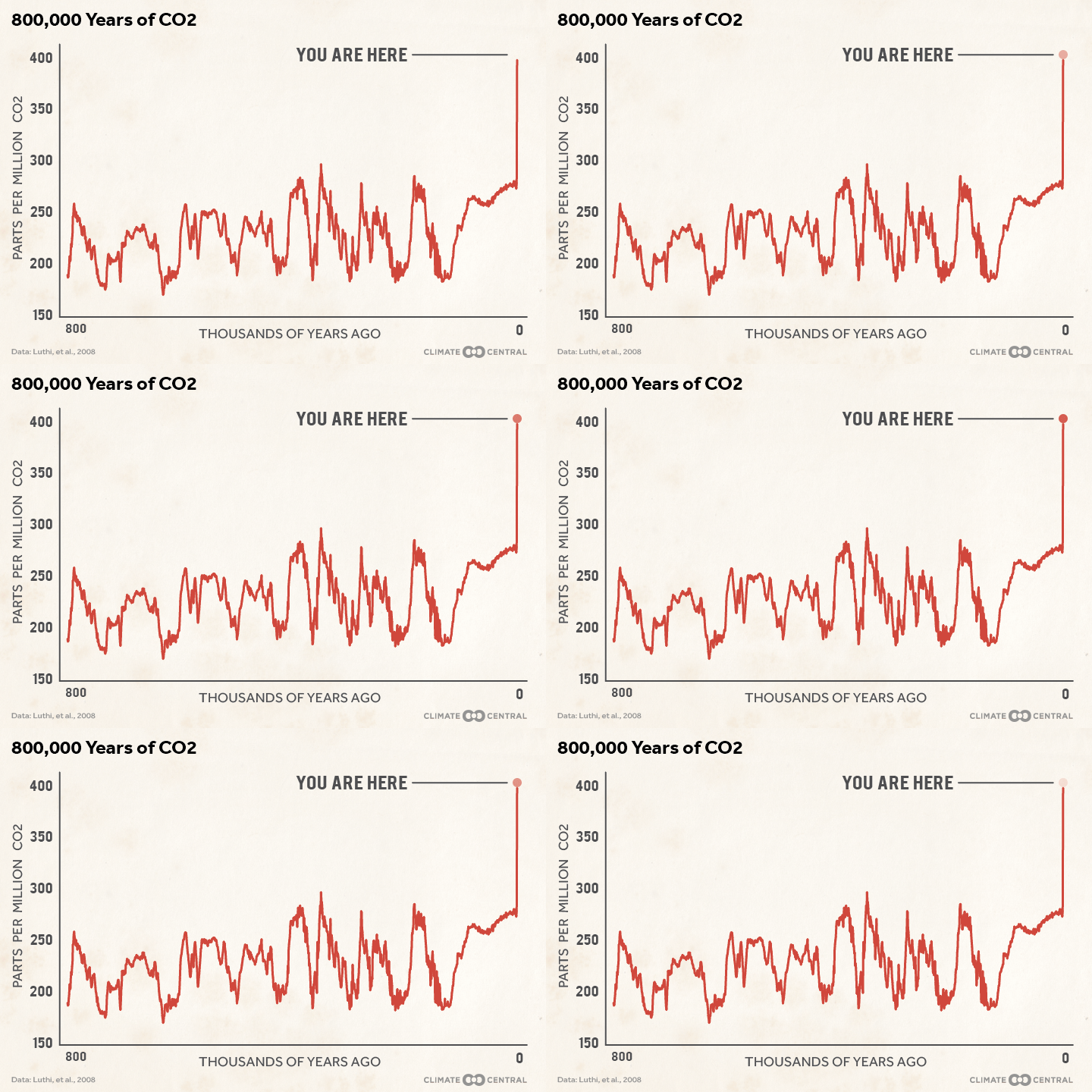
The state of CO2: now around 400 ppm, 20 years ago was 350 ppm, and that was already more than during the last 800 thousand years, and now it's increasing unbelievably faster:
If 5 degrees is a mass extinction event (I'm just using your numbers here, not positing them as facts of my own), how can you characterize 1-2 degrees (20-40% of your mass extinction event number) as a "small" issue?
As an "engineer" (note: software engineer, not a real engineer), I'd prefer to leave as much wiggle room as we can possibly muster on the spectrum of activities heading us towards "mass extinction event".
Actually "warming -> melting ice -> less reflection of sun -> less heat" would go other way around. If you have light surface it's likely that lot's of visible light is radiated to space. If you have blue sea instead it's likely it radiates only infra red. Which would be bad with elevated CO2 levels.
The most believable negative feedback I have seen is about increased cloud coverage. Clouds should then reflect visible light back to space. At the same time water vapor is the most significant greenhouse gas in the atmosphere. We really don't know how it's going to turn out.
I suspect simply because the 1-3% who are skeptical are literally excommunicated from the scientific community. The problem is that it requires a belief. While we have evidence, there is no conclusive proof, since it's it is difficult to "test" in this field of science.
Cook should do surveys for these questions too (and include replies from more than 100 people):
If human activity is causing global warming, is that a good or bad thing?
If that is a bad thing, does it present an existential threat to our civilization?
If it presents an existential threat, is it the most significant existential threat our civilization currently faces?
If it presents an existential threat, can our civilization do anything about it?
Where does the danger of global warming rank compared to the danger of, say, population growth? Other pollution? Terrorism stuff? Nanobot grey goo?
If our civilization can do something about an existential threat from global warming, could a cap-and-trade or some other kind of government policy be a good solution?
If etc, could the dynamics of our culture, markets, or technology be a good solution?
> The result confirmed that the predictions of general relativity were borne out at the 10% level. This was later improved to better than the 1% level by Pound and Snider. Another test involving a space-borne hydrogen maser increased the accuracy of the measurement to about 10^−4 (0.01%).
Nutrition and diets are more difficult to measure (you can't enclose a few thousand persons in the lab for 20 years) and it's full of side effects and interactions. IIRC a low fat diet is still recommended. I think that a better example of the changes in nutrition is the butter vs margarine recommendations, see for example http://www.telegraph.co.uk/news/science/science-news/1179683...
> The climate researchers are able to dig back literal millions of years and chart their findings.
sorry, this is pretty funny. Do you know what the data those charts of millions of years are based on? models based on thin evidence and scant data. We are talking like 10 ice cores and 5 trees will swing the data wildly.
I am not a denier (CO2 causes some warming!) but this comment was kinda funny.
Remember the "global warming hiatus" that happened over the past 15 years? The one that most climate scientists accepted? Well, it looks like the models we're wrong. Tweak a few model input and "oops!" it's actually been warming the last 15 years.
For decades, scientists, doctors and dietitians said that eating fat caused heart disease, and you should decrease your fat in your diet. Only in the last couple of years has this "fact" been deemed wrong.
I don't think you would have found a single scientist, doctor or dietitian since the 70s that would have disagreed with the above. It was taken as fact and anyone who thought differently would have been a laughing stock.
The same goes with global warming caused by CO2. It makes for an easily digestible theory, but it doesn't explain many known facts. Global warming caused by CO2 has never been proven, obviously, since you can't do experiments on a global scale. So there's already a lot of faith that you would need to take into consideration. There's circumstantial evidence at best. But still a lot of unknowns about climate and the vast changes that the Earth has undergone over the last 6B+ years, so to say that we know that the current warming trend is caused by CO2 to me is not science.
If you read this thread, it's humorous to read all of the people who think that there is data going back millions of years that links CO2 to climate change. It's a great example of how regular people just take whatever is spoon fed to them without thinking "really, does that make sense?"
For example, North America was covered in ice at one point, and the temperature increased dramatically over the last hundreds of thousands of years. What caused this, and could the same process be responsible for the warming we have seen in the last several decades?
The 5000 year old Iceman found in the Alps attempted to cross the Alps when there was very little snow. We know this because of the clothes that he was wearing when his body was found. So obviously the climate was much different 5000 years ago than today. What caused this change, and could the same process be responsible for the warming we see now?
We know that during the Medieval Warming Period, it was a lot warmer than it is now. What caused this change, and could the same process be responsible for the warming we see now?
I would like these questions answered before I change my opinion. As a man of science, I see too many people flocking like sheep to the answer of CO2 causing climate change. Just like the whole fat-in-the-diet belief, too many people don't really think, they assume that the scientists are right, which is not thinking, in my opinon.
>If you read this thread, it's humorous to read all of the people who think that there is data going back millions of years that links CO2 to climate change.
Except... that data does exist. Sediment cores do contain evidence of past levels of atmospheric carbon dioxide to a fairly high degree of accuracy, and we have sediment cores going back up to about million years ago, or so.
>Global warming caused by CO2 has never been proven
Sure, you can't do a double-blind randomized control experiment with the earth, but when two variables are clearly correlated with a time difference, over millions of years, controlling for confounding factors, it's pretty clear that one causes the other.
>For example, North America was covered in ice at one point, and the temperature increased dramatically over the last hundreds of thousands of years. What caused this, and could the same process be responsible for the warming we have seen in the last several decades?
According to Scientific American [1], the last ice age ended because of a rise in atmospheric carbon dioxide.
Except correlation doesn't prove causation. How many times does this have to be stated for people to understand this? The number of pirates is perfectly inversely correlational to the atmospheric CO2. Is it pretty clear that one causes the other?
Sediment cores and being able to extrapolate data going back thousands or millions of years is a theory only. No one can state CO2 levels going back thousands of years with any level of certainty, certainly not in the Ppm accuracy.
Yes. It's not as far out of the historical norms as CO2 levels, but the gradient on it is astounding. It's taken us about 100 years for temperatures to rise beyond their last peak, which occurred about 7000 years ago [1]. Note that this is precisely coincident with the rise in CO2.
It's true that there's a historical feedback loop between CO2 and temperature, which operates in cycles. But we are now operating far beyond the usual range of that system, whatever it is, and nobody knows exactly what will happen next.
The wikipedia chart covers 450 thousand years on the x-axis, and a 14 degree range on the y-axis. Your chart covers 12 thousand years on x and 2 degrees on y. If your chart was shrunk to the same scale and overlaid on the first chart, it would be lost in the noise, and your astounding gradient would be nothing compared to the rises and falls 20K and 140K years ago, among others.
The point of that chart is that the temperature appears to go up before the CO2 levels, leading to the theory that higher temperatures (due to natural cycles, perhaps solar activity cycles) heat up the ocean and other CO2 sinks, leading to a rise in atmospheric CO2.




EDIT: That's not rhetorical. I'll entertain any logical reasoning you have as to why your reasoning is superior to those educated and practicing the subject daily.