Not exactly the same thing but I have been thinking about the idea of 3D construction of cloth/jeans you want to purchase onto your own body, so that you have better idea before placing order, which could be really useful for online shopping.
I was thinking in game graphic way (bottom-up), such as building 3D model of myself, shopping website providing 3D models of their clothes, and then it would be a "fitting" problem to properly place clothes onto the body.
From this paper it seems that it is not necessary to have low-level data to achieve the objective.
In the early 2010s, I did a security evaluation of Styku's Kinect-based fitting room. Back then, it was in a similar vein as what you described - the sensors would build a 3D model of your body, and then recommend the jeans that would fit best.
Their original idea was even better, IMO. It was supposed to send the model to an on-demand automated clothing factory that would custom-sew entire pieces of clothing to your measurements.
I think the technology wasn't quite there yet at the time. Even with four first-gen Kinects, the body model was probably too inaccurate to compare to an actual tailor. They seem to have moved away from clothing in general since then.
Unfortunately the human body deforms from clothing...
I have most faith in energy-dispersive CT or MRT to provide the required information about bone shapes and tissue types to extrapolate how a garment works while moving.
Even much more so for shoes that I think need shape customization the most.
"The point of most cryptography and security features is to use math to represent and symbolically transfer liability and risk between transaction counterparties"
What is the liability here? For example, the company holds different level of liability in a data breach, depending on whether they implement the security correctly - is that what you mean?
Example would be whose keys encrypt and decrypt data realizes legal things like custody and control and the associated responsibilities.
One area that has recently changed is "de-identification," which used to essentially be a cryptographic problem, but now it's a legal definition where you assert a policy about the data encoded in a way and subject to a risk assessment to make that assertion, and then the de-identified data (PII/PHI) now comes with obligations.
Another example was chip/pin payment cards several years ago, where they transferred liability to the merchant for fraud and chargebacks, where previously, magstrip meant the liability for chargebacks largely stayed with the issuer.
If an online banking account gets hacked, banks have less liability than they did previously - as even though you must assert it was they who were robbed and not you, and they still owe you the money you deposited with them, enhanced authN/MFA has allowed them to imply it's somehow your fault that someone stole the money you trusted them to hold for you.
The security of each tech divides the liability between the parties in these cases.
An informal perspective on some implication of Monte Carlo on integral:
One of the most intuitive (and used in applications) definition of being integrable is Riemann integral based on the geometric idea that you can compute the area/volume by dividing region into pieces and summing them all up. Now you can (mathematically) prove that for any such integrable function, its integral can be approximated by Monte Carlo and the results are consistent.
Now what about the other direction? You can theoretically run Monte Carlo approx on wildly zigzag functions that does not make any geometry sense (i.e. not Riemann integrable), if the "probability" in the space is well-defined. The idea that uses probability, instead of geometry, turns out to give a broader class of integrable objects.
One interesting observation is that these ideas are intuitive and meaningful if put informally. But when you formally look into these ideas (integration/measure theory) it suddenly collapses into lines of terse mathematical constructs.
You’re certainly aware of this, but for those that aren’t: asking that the “probability” in the space to be well defined you are essentially invoking the idea that the function is _measurable_. Measure is a way to generalize things like length and volume to sets which have no length or volume in the traditional sense. One good way to do this is say that lines have “measure” equal to their length, and if you can combine line segments(even infinitely many) to get some new line then that line has measure as well. If you do make this precise, you get the so-called “Borel measure” on the real line.
If you want all subsets of sets with 0 Borel measure to also have 0 measure, then this leads to the notion of the lebesgue measure, and it can be used to define the lebesgue integral.
a) But for probability you nees the measure of the whole space to be 1, which forces points “far away” to have very small “weight”. Thus, there is no uniform distribution in the whole R.
b) and then your mind blows up when you realize that discrete probability is the very same thing, and that an integral in a finite set is just summation.
Yeah to add to this when you study probability at a more advanced level, you learn that really what a probability is "just" an integral ie P(x) = integral{Indicator function(X)}. So it's actually not a crazy object to pop up when you're thinking about integrals and integral approximations.
In many rpgs as you progress through the game the need for expenditure diminishes to zero. Different case if it is mmo or designed around grinding though.
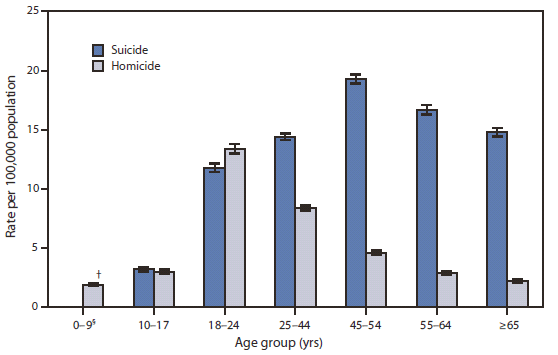
The overlapping decreasing line curves of mortality due to infant / child mortality cases and increasing line curves of mortality due to external factors, accidents, and illnesses. The lines cross around 10 yrs old.
While that's true, these are small death probabilities. The age 10 death probability is less than 1 in 10,000. It doesn't even reach 1 in 1000 until age 20 for men and age 34 for women. According to this data source[1] there are about 4 million 10-year olds. That works out to less than 400 deaths for the entire US in a year.
What I find interesting is the divergence at age 10 by gender. By the late teens, boys are about 2.5 times more likely to die, in spite of the probability being the same at age 10.
I wonder if it's accidental behavior because of not knowing better (children crawling into water or streets etc) combined with accidental behavior because of being teenagers crossing over.
Your reasoning is interesting. A non-shocking (in the sense of statistics and its likelihood on base population) event being posted and shared in digital media can result in reciprocally huge media effects.
Here is my kettle logic for you to not even try getting around that paywall:
Old papers that are not publicly accessible on the web are very likely just a pile of craps and not worth reading; even if it was worth reading, its information should have been compiled in better ways in textbooks/blog posts; if neither were applicable, then you are supposed to be some researcher working in academia and can ask your institute to offer the access.
Second on John Williams quotes as his novels were my favorite.
I just want to mention that in Williams original narratives he is far from being sarcastic/playing wits or suggesting life meaninglessness. Instead, it is in the sense of indifference (neither positive nor negative).
If you plan to read his novels, I suggest reading both Stoner and Augustus and explore their interlacing
"When it comes to open-world games, I’ve never liked the “fakeness” of the open-world and why games like Skyrim, Horizon, the Assassin’s Creeds, and so on, didn’t interest me."
Skyrim and AC are milestones in open-world design around 2010. Sort of mind-blowing if you played them at their initial release. Horizon, though not being top, also has its own merit. I wonder how can an author comment on open world design when literally any other open-world game does not interest him.
I could just be angry because he acclaimed ER without being fair about game design as a progress over time.
You have a good point.
I imagine the author tried many of the older open world games of the previous generation, like Farcry 3, Assassin's Creed 2 games, and likely GTA4 and 5. They were incredibly novel for the time.
Now we're at a point where open world games are a dime a dozen, and for good reason: they sell. They're easy to understand, simple to drop in and out of, and many of them now have multiplayer. Rather than aiming to make an immersive world to get caught up in, companies run them as live service games with a drip feed of content―essentially a big sandbox that I can mess around with my friends in. On the flip-side, Breath of the Wild is strictly single player, but it has a lot of fun systemic features that combine in interesting ways (weather, elements, physics, etc), making it feel like an experimental sandbox of its own.
Elden Ring is basically a Souls game with two major innovations for the series:
- Previous games had mostly linear progression. Elden Ring opens up the world to the player and gives them tools to explore without penalty from the start (fast travel, for example).
- Outside of interiors, the player is afforded much more mobility because of their mount. They can outrun almost all overworld enemies, and do hit and run attacks (Interiors are traditional Souls challenges).
These two points, combined with a generous allied NPC summon system, means that the player has a lot more options in how they want to approach the game. In previous Souls titles if you reach a boss you can't defeat, the game is over for you. Elden Ring is structured in a way where you can just go in a different direction, and warp back to that boss when you feel more confident. The environmental storytelling, cryptic NPC dialog, and multiplayer systems are nicely tuned to fit the different affordances Elden Ring provides, but they're not wildly different from previous Souls titles.
Horizon Forbidden West feels overly polished. Like they brought in the best people to improve things but the end result is like eating 12 courses of the same perfectly prepared chicken breast. It’s good but feels like it’s missing something the guest had. Its story isn’t bad, you feel urgency and care about the characters. There’s powerful moments. It checks the boxes. But this gives the game a dramatically different feel from the first.
HZD seemed to generate a lot of discussion about how it’s a great science fiction story, and it is, but it’s also a really dark tale that feels hopeless even when you know how it ultimately plays out. It told two very different stories side by side and one of them was a history in our future that was utterly bleak and it told you in a way that held little back. It truly felt like every time you thought it couldn’t get any worse, it did. And then Ted Faro murdered the Zero Dawn architects and deleted all of the teaching data thus dooming an entire world of unborn children to a life free from safety, food security, needless infant mortality, medicine and reading. All to hide his shame from a future he wouldn’t even be alive in. And then we learned he got to go live in his bunker while Elisabet suffocated to death in front of her childhood home. It was infuriating but fitting.
There’s bits of that sprinkled throughout Forbidden West but they’re not given the stage.
It was kind of an impossible task for Forbidden West to replicate the experience of Zero Dawn.. to me the magic of the first game was entirely based around the discovery of why the world became the way it did. The mystery of the second game is not about the state of the world, but instead one cliffhanger aspect from the last game (what caused Hades to go rogue?).
But I’m in complete agreement about with the OP about the “overpolished” aspect of Forbidden West.. just check out the Horizon subreddit right now. They just released a patch that nerfed the legendary weapons in the game. There was no real reason to do that. They didn’t feel horribly broken (especially for how much grinding it takes to upgrade them and how expensive their ammo is to craft). And come on: it’s a single player game. No idea what’s going on at that studio right now.. maybe gearing up for DLC.
I platinumed Forbidden West yesterday. It is a beautiful game. But it lacks the magic of the first one where I was walking around slowly around the world wondering what might have happened. Now I know. And it can't be replicated. It's hard to follow-up on such an experience and what the team has achieved is nothing short of amazing. Of course, there are a bunch of things that don't work well.
The weapon- and armor- tiers don't relate well to the progress in the game. They nerfed the legendary because everyone was skipping the purple ones making them entirely irrelevant.
Sometimes the moral justification / social justice police is a bit heavy handed in a game that is set 1000 years after a full-reset apocalypse.
LGBTQ+ representation, Climate change (Lombard street), Handicapped acceptance (Kotallo) etc you name it. I get it, I don't really mind.
Also the game follows the bigger evil fallacy which leads to the main character needing to become a super-hero to "win". I mean Aloy is already at that point, I guess. For example there is a several ton heavy fireclaw that jumps on you at every occasion. I don't see how a person would survive that. Hence it is a bit immersion breaking.
I just picked up Forbidden West but haven't had a chance to play it much yet because of a big work push (no spoilers, please). I completely agree with basically everything here. The game is a blast so far but I'm not sure how they could top the first game so I've been trying to measure my expectations.
I was talking to a coworker about it and the first thing he asked me is, "What about all that amazing gear you get by the end of the first game?" which I think perfectly illustrates your point. They took Aloy to the top and although they managed to make it work so far it does feel a bit awkward, like they may have jumped the shark. But hey I'm just excited to have a cool game to decompress with. I guess in the end it's not that different than a sequel to a movie. People who loved the first will more or less come back to see the second.
My partner is playing through forbidden west right now. As a spectator it’s fun to watch her explore. It’s actually Amazing to me how they created the worlds. I did enjoy watching zero dawn as well.
The game developers conference releases a lot of great talks. Some on horizon zero dawn where pretty interesting.
HZD overwhelmingly felt like belonging to the same "fake open world" trope as described by the author to me though. Apart from the enemy types and combat mechanics it's really hard to distinguish it from your run-of-the-mill AC game - it has the same feel of repititive missions scattered across the world as a distraction from the main storyline. Rather, AC at least tries to make its characters look lively and have individual traits. HZD's forced dialogues with its excessively lifeless and mechanical characters are abhorrent and were a huge deterrent for me against completing the game.
> Skyrim and AC are milestones in open-world design around 2010
Yet it bored me to death. So empty. Such a terrible rhythm.
I understand why people like it, I get the game qualities, but I prefer much more density in my games.
When I played the witcher 3, I enjoyed it. But soon, I got lost in side quests. I could not even remember the main quest anymore. And side quests took me so far away, going back would have been sometimes long rides of boat and riding.
GTA had a different problem: it was very repetitive. I didn't feel like moving from one part of the city to another, I was discovering another part of the world. Just a variation of what was already existing.
That's why BoTW was the first open world I deeply appreciated: there is always something to do, anywhere, something do discover and get excited about. And going off and on the main quest is quick, easy, seamless. You can do it over and over. Also, the game is not just beautiful, it's a piece of art.
I never stopped in order to admire my surrounding in skyrim or the witcher. Not that they cannot be nice looking: max res + mod can make them outstanding. But they don't touch you inside in the way a Nintendo game landscape can, Miyazaki style. They get you attached to character much better though, so there is that.
I believe Elden Ring went for that density, that artistic quality kind, that flexibility, in a sort, that lean aspect of open world exploration. Except you get your ass kicked and then the game spit on your grave.
Purely personal opinion - I played about ten hours of the first Horizon and I was blown away by then graphics. I liked the story and the characters and the world design.
The actual gameplay and how it was connected to the world, unfortunately, I found boring and ultimately I decided to stop playing. I had the feeling of being here before from every other open world RPG I've played in the last 15 years or so and I didn't feel like anything new was added beyond a few incremental tweaks. I didn't feel driven to explore the world and I felt it was just going to be filled with samey fetch quests and dungeons.