In the English language, "America" refers to a country. It is synonymous with "The United States of America". I say this as someone who lives in the same continent as that country, but not in the country itself.
Maybe you're thinking of "North America", "South America", or "the Americas".
Probably. There are a lot of countries, especially third world ones, with very lax legal systems, not to mention the multitude of countries where law basically doesn't exist.
Failing to do X doesn't make Y a good idea. You haven't engaged with the argument I made favoring to instead repeat a politically charged misrepresentation.
"Meh I'm okay with it" is by definition not a counterargument but rather a nonconstructive dismissal of whatever it is a response to.
You can in fact have both. You can have a tool that is fully functional and separately you can have a strategy for reporting suspected violations and responding to those reports. Reports can be automated assuming you can tolerate the false positive/negative rate. Particularly in the case of a subscription service such as Claude there is little reason not to implement this other than sheer greed or laziness.
In the case of Claude in particular, an unacceptably high false positive or negative rate also poses a serious problem for the current way they do things. The notable difference is that in the case of false positives it currently runs up a bill for the customer rather than the service provider.
It's not a stupid thing - GitHub not being serious about basic reliability is, at this point, a big risk to people depending on it for change management, much less OSS projects needing it to do every aspect of work in the public.
GitHub made working in the open a joy. It's very sad the state that it's in.
Since if a rational actor would understand that the group can avoid ever dying to this game by simply choosing blue. There is no consequence for choosing blue - but there is a consequence for choosing red.
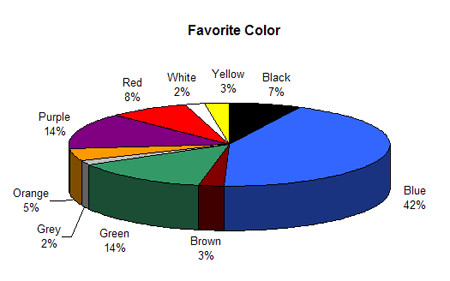
Also, regardless of these specific consequences, people who are rational/ethical will by default choose blue because it is a good color.
People's "by default" behavior will never define what is rational. You don't do polling to choose rationality.
If there is a game in which you choose between two buttons, you know everyone will get this same choice, and one button says that you definitely live and the other button says that there's a chance that you will die, adding more rules to the "maybe death button" can not make it a more rational choice.
This is actually an experiment that I would get behind doing in real life. I will pick the red button. We could do it every morning.
There are enough collective action problems with real and obvious benefits leading to catastrophe without the need to create more unnecessarily, or to have any confidence in in a world full of strangers' collective ability to solve them. Campaigning for blue is actually murder; you've encouraged a situation that may result in the deaths of 49% of the population.
There are two globally optimal solutions to this problem: > 50% pick blue (saving everybody), and 100% of the people pick red (saving everybody).
There is only one Nash equilibrium, which is for everybody to pick red. This is also strictly dominant for each player (if they choose red, they have a 100% chance of surviving, while if they choose blue, they only survive if > 50% of other people also choose blue). Knowing this, every participant has an incentive to choose red.
You can have a system that is rational even if the individual participants are irrational. Among the mechanisms for this are statistical (if any given member of the population frequently makes errors, but the errors average out to the overall rational solution) and selection (if all the irrational people die and drop out of the population, which seems to be the case here).
Only irrational people will pick blue. Let's say that's ~3% of the population. Trying to get another 47% of the population to pick blue risks losing all of them as well. That's not ethical.
The simplest answer is that everyone should pick blue, actually.
This is because choosing blue results in no consequences, but choosing red does result in consequences. Why not choose the simple option? It's literally the "no consequences" button.
Seems like these reds are overcomplicating a simple question.
And where in the original post is specified who does "the murdering"? As far as I see blue pressers are explicitly putting themselves in harms way and red pressers have fuck all to do with it.
Just because someone jumped infront of the train and died doesn't mean the conductor is a murderer.
The red pressers commit murder. If people don't press red, the blue pressers don't die.
Train conductors and companies take reasonable precautions to avoid killing people - they aren't indifferent to it. If they just built tracks and started running trains on them without taking measures to avoid mowing people down they absolutely would be guilty of murder.
For it to be murder it would need to be unlawful (lets just assume this entire hypothetical is unlawful) and planned, so unless red pressers are specifically doing it to kill blue pressers it is factually not murder. Blue pressers have put themselves into the situation of possibly dying, which was entirely their choice and isn't the responsibility of anybody else (ignoring the "forced to press a button by some mystical force/being").
There is a reason why even "duty to rescue" laws usually do not require the rescuer to endanger themselves doing it, which in this case would most certainly be the case (going from 0% of death to "who knows, this is entirely out of my control but non-negligable chance of dying" % of death).
> If they just built tracks and started running trains on them without taking measures to avoid mowing people down they absolutely would be guilty of murder.
Most stations in the world do not have any guardrails to the tracks themselves. If someone decides to walk onto them as the early end of a station they will most likely die if the train is arriving. The tracks were there, the train was scheduled just the person decided to put themselves into harms way. At most it would be considered manslaughter.
> For it to be murder it would need to be unlawful
You have this backwards. It is unlawful because it is murder and we have laws against murder, not the other way around.
You might be thinking of "felony murder", which is a way some places promote crimes that wouldn't otherwise be murder to murder if someone happened to die in their commission (e.g. you intended to rob a bank, and the bank guard shot someone else trying to stop you, so now you get a murder charge) but that's not necessary when you are the one intentionally performing the action that you know will kill people.
> so unless red pressers are specifically doing it to kill blue pressers it is factually not murder.
This isn't how "intent" works. This would be like saying "I shot the opposing soccer player so I could win the soccer game, not so that he would die, so it's not murder". Intent requires that you intentionally performed the action that could result in death, not that death was the goal. I.e. the intent requirement means tripping and falling and accidentally pressing the red button wouldn't be murder, choosing to press it would be.
Similarly if you're falling off a building, and you somehow have the option to pull some bystander off the building throwing them to their certain death but saving yourself, it would be murder to do so.
> There is a reason why even "duty to rescue" laws usually do not require the rescuer to endanger themselves doing it,
We're not in a "duty to rescue" situation, merely in a "duty not to commit murder" one. There is no duty to press the blue button, merely one not to press the red button. That the scenario apparently leaves no other choice but to press the blue button is irrelevant.
You could imagine a 3-choice game. If more people press the red button than press the blue button everyone who presses the blue button dies, but you can also not press any button and not be at any risk. Pressing the red button is still murder, but you're under no obligation to press the blue button and put yourself at risk to potentially save other blue button pushers. Doing nothing is not a crime... but the red button is just as much murder in the 2-choice game as it is in the 3-choice game.
A single button labeled "Murder" appears out of nowhere appears, and if more than the majority of people press it, then the people who didn't press will die.
I'm pretty sure most people would just ignore and keep going with their day since why would everyone in the world be so cheesed to press the murder button?
Anyways, these are all reductive scenarios once outside of game theoretics (like this one partially is) - I find this ragebait question really funny because every minor reframing shows significant biases in how you map the theory of mind for the public, and makes the reductive question entirely different.
The framing leads many people to pick blue for its altruistic framing. Enough, in fact, that 50% quorum is honestly not difficult. A lot of red-advocates seem to have a False Consensus Effect going where they're convinced way more people than in reality will interpret this "dilemma" as "do you step in the human grinder in hopes of jamming it", and act accordingly.
A 70% or 90% requirement, or just explicitly framing it as "do you step into the human grinder" would make it vastly easier to aim for 100% red, but we're dealing with the literal words of the "everyone lives button" here.
Missing the layer where blue is my favorite color and therefore I will always choose blue. From this perspective, all other reasonings lack basic empathy and/or intelligence.
Another example of a long list of stories where GoDaddy practically destroys decades of business trust for a customer by just ripping their domain away for no reason. What an awful company.


reply