The 2011 action in Libya was an international effort carried out under a UN authorization to protect civilians, not a unilateral move by Obama based on a fabricated rationale. There were limited airstrikes and aid to rebels, but the US did not directly take out Gaddafi or make any pretense of "running the country."
Obama deliberately went to Congress for authorization to strike the Syrian chemical program in 2013, and after it quailed from taking a vote, the strikes didn't happen.
The 2014 strikes were against ISIS, not Syrian government forces, and carried out under the existing AUMF authorization to combat Al Qaeda and its affiliates. One can argue whether ISIS qualified (even the administration at the time acknowledged it was a stretch and wanted a more clear-cut resolution from Congress), but it definitely was a major terrorist threat in the region and had been working with AQ in the past.
consulting company i work at hired a grip of these people for construction and public land projects. struggle with guilt that our success is the result of capitalizing on incompetence and lies
we certainly charge at least 3x cost for gov to employ them on top of whatever severance they might have received. the work still needs to be done and specific people know how to do it. sort of becoming a staffing agency because theres so much profit in it. makes my stomach sick writing this out
We use Nara to track our baby's food intake and sleep.
A couple of months ago I noticed Little Snitch complaining about the app making new connections to malware domains. Thankfully I can run the app on macOS and noticed it.
When confronted with how this violated their Privay Policy, they gave a condescending reply. When I contacted Apple about this new update to the app, they ignored my report.
So… no, we're not safer on iOS. Perhaps the barrier to entry is a bit higher to discourage some low-hanging fruit, but Apple does very little for the 30% commission it takes.
It's largely a political issue. At this stage you can't create alternatives to Google and other U.S. tech giants without removing them from the market (so essentially the Chinese approach, which has allowed them to build their own massive tech giants). But that path is nearly impossible for the EU due to the risk of U.S. retaliation. The EU can't even implement a digital tax.
You also can't just say, "Here's a few hundred billion in public support to create alternatives to U.S. tech giants", because the U.S. would argue that it's unfair state aid and retaliate.
There isn't enough private capital in the EU with the risk tolerance required to take on such a challenge independently.
We also lack a reserve currency like the USD, so we can't print $2 trillion a year, much of which ultimately flows into the U.S. stock market and further boosts U.S. tech companies, making competition even harder.
EU markets are already fully penetrated by U.S. behemoths that can either withstand or acquire any privately funded competitor, thanks to their massive cash flows and valuations.
For all these reasons, the outlook isn't very promising.
Isn’t all this company is the product stuff an obvious side effect of wealth inequality?
There is way way more money up top looking for investments than there is in the hands of customers, so it’s far more profitable to chase that money and make the stock the product than it is to care about the actual product much.
It’s a special case of the more general big dumb money problem that happens whenever too much money ends up in too few hands, whether those hands are a government or a few private rich citizens. You end up with this giant piñata of big dumb money and everyone whacking it.
In the old USSR instead of the stock is the product it was the appearance in the eyes of other bureaucrats is the product, but it’s kind of the same phenomenon. The customer isn’t the customer.
There really is a few comments here with great suggestions for how to improve your resume and online presence. It seems like some of it can still be tried, or if you feel it was already tried but got rolled back, then they can be tried again altogether.
Unfortunately, there's also a lot of noise here too... As a start, I'd say these few comments have solid, specific, actionable suggestions:
But I also want to say... I sympathize and agree with you that it's tough now out there. There's ageism, offshoring, AI, end of ZIRP, economic uncertainties, etc.
I hope you get to a position you're happy with soon.
> Remember that China promised trump in term 1 to massively import US goods and reduce fentanyl
China stopped selling unlicensed fentanyl to the USofA, it later stopped supplying fentanyl to both Mexico and Canada.
The problem was that criminals in the USofA and Mexico purchased precursor chemicals in bulk and made their own fentanyl. Restricting precursors led to pre-precursors being purchased in bulk for drug labs to make their own precursors in order to make fentanyl.
The fentanyl problem continued under Trump and rapidly grew in size during his first term.
  In 2021, Mr. Biden issued an executive order imposing sanctions on individuals and companies engaged in the illicit opioid trade. His Treasury Department put sanctions on more than 300 individuals and entities, freezing entire networks of fentanyl suppliers and traffickers out of the international financial system.

  In 2023 and 2024 he identified China as a major illicit drug-producing country for its role in the synthetic opioid trade — a blow to the reputation of China’s chemical industry.

  Simultaneously, the Biden administration pushed U.S. law enforcement agencies to conduct aggressive investigations and build indictments against dozens of Chinese citizens and companies that were trafficking fentanyl precursor chemicals into the United States.

  [..] Biden secured a personal commitment from President Xi Jinping to restart counternarcotics cooperation in November 2023

  [..] And we made progress. International fentanyl supply chains showed signs of disruption, forcing traffickers to change sources and tactics.

  Together with other diplomatic initiatives and an expansive public health campaign, the number of lethal fentanyl overdoses in the United States has dropped.

  In the 12 months ending September 2024, overdose deaths were down an estimated 24 percent from the year prior.
What has Trump done now he's back in office? Destroyed any cooperation with China on counternarcotics cooperation.
  Tariffs alone will not push China’s government to help reduce drug overdose deaths in the United States. In fact, with Beijing already imposing retaliatory tariffs and proclaiming that it’s “ready to fight till the end,” Mr. Trump’s blunt-force tactics might drive China to cooperate less on fentanyl, not more.

  With the stakes as high as they are, American communities cannot afford a miscalculation.
> I ponder if it's really because sedan sales have been shrinking
Nope. It's part of Honda's $4-5 billion US expansion as part of their EV and Hybrid car drive [0][1] which also expanded production output.
They're moving their cars to a hybrid and electric first model similar to what Toyota began 4-5 years ago.
The Biden era IRA subsidizes were the carrot to help restart domestic automotive investments, and the tariffs shock is the stick to force them to capitalize on those instead of trying to co-mingle parts from other non-NAM locations for better margins.
> With a Canadian or American passport (until recently)? No problem.
First of all, the folks profiling and detaining you don't ask you where your passport is from first - they'll generally make the decision and then ask for your documentation.
But even then, I have a US passport, and I've had far more issues being detained in European airports than I have in the US - which is really saying something.
If a country decides that it is important to not be a net importer the method to achieve that proposed by Buffett in the article is infinitely better than the way Trump is going about it.
Essentially what Buffett suggests in the article is a cap and trade system on imports.
To import $X worth of goods the importer must have $X worth of ICs (import certificates), which consumes those ICs. ICs are created when exporters export, with each dollar of exports creating a dollars worth of ICs.
ICs are tradable so an exporter does not have to use the ICs created by their own exports. They can sell them to importers.
Note that under this system it is perfectly fine to have a trade deficit with any given country, as long as their are trade surpluses with other countries that balance it.
Trump wants trade with each country to be balanced (or a surplus).
Consider this hypothetical.
• Country A needs to import some natural resource. They import it from country B and use it to manufacture something.
• Country B doesn't need anything that A makes, but does need something from country C.
• Country C doesn't need anything from B, but imports the thing A is manufacturing.
If Trump were running country A he would view this as A getting ripped off by B. Under Trump logic B would be getting ripped off by C, and C would be getting ripped off by A, but he wouldn't care about the former and would probably by bragging about the later but not calling it a rip off.
One of the big reasons money was developed in the first place was so goods did not need to be balanced between each pair of traders.
Before money if a farmer had chickens and wanted a goat he had to find someone who wanted chickens and would trade a goat for it. If the only guy with goats he could find didn't want chickens but wanted a pig the farmer was out of luck, unless he could find someone who had a pig and wanted chickens. It can keep going...maybe pig guy wants a cow so now the guy with chickens also needs to find someone who will trade a cow for pigs.
Money made it so trades become money for goods instead of goods for goods. Chicken guy just needed to find someone with a goat for sale for money instead of finding someone with a goat who specifically needed chickens.
Same thing applies to trade between countries, and for some inexplicable reason Trump wants it to work like the old chickens for goat days.
Interesting point. I hadn't thought of it this way before:
> But imagine that the Japanese both want to get out of their U.S. real estate
and entirely away from dollar assets. They can’t accomplish that by selling their
real estate to Americans, because they will get paid in dollars. And if they sell
their real estate to non-Americans—say, the French, for euros—the property will
remain in the hands of foreigners. With either kind of sale, the dollar assets held by the rest of the world will not (except for any concurrent shift in the price of the dollar) have changed.
> The bottom line is that other nations simply can’t disinvest in the U.S. unless
they, as a universe, buy more goods and services from us than we buy from
them. That state of affairs would be called an American trade surplus, and we
don’t have one.
> But under any realistic view of things, our huge trade
deficit guarantees that the rest of the world must not only hold the American
assets it owns but consistently add to them. And that’s why, of course, our
national net worth is gradually shifting away from our shores.
The big prediction that was wrong is that the US dollar would lose value. The opposite happened - despite all the deficit trading, the dollar has gone up in relations to all other countries.
It's a self-correcting problem - if the dollar starts losing value, that strengthens or our ability to export. And if countries want to manipulate their currency to maintain their ability to export, then they are helping pay to maintain the balance.
No ... they do not make the US poorer. Trade deficits make every other country poorer, but not in the case of the US. That's the "deal" that Nixon forced at Bretton Woods.
Why the difference? Because they're measured in USD: if a trade deficit makes the US poorer, the US can simply print dollars until they've recovered whatever they've lost, or more.
Another huge problem in the article linked: "a trade deficit is like buying stuff with a credit card". True, but I would emphasize VERY strongly that it's a credit card with a MINUS 4% interest rate.
The US gets to print money that is accepted worldwide (and countries accept that their central bank holdings, minimum X, get devalued at on average 4% per year), but the US side of the deal is that the US provides a market for worldwide goods and hoovers up excess production capacity of essentially the entire world. (there's more to it, like the world bank, but ...)
The deal is that this massively raises world economic output, as long as the US has massive, perhaps not unlimited, but massive trade deficits.
TLDR: for the US, the deal is, free money but you don't get to do protectionism. For the rest of the world, the opposite. Every dollar is accounted for BUT they can be as protectionist as they like (and they are). Oh and only the US gets to make huge loans to the rest of the world.
An issue with this is: all the free money in the US is disbursed through US banks and, essentially, put in the stock market (with a -small- percentage going to the US government). It took the banks 50 years, but they figured out how to keep it enough for themselves to make the system sputter. Of course, the issue the banks have is: the system has been sputtering since, oh, 2019 or so. If it breaks down, the stock market will not drop 10%, but 95% at least. THAT's the risk Trump is messing with.
But Trump is also right that it is Europe and China that broke the deal, not the US. China is trying to create a parallel reserve currency that they can print, the "digital Yen" (+ the belt and road initiative). Europe has created the Euro while remaining protectionist. Both are existential threats to the US' reserve status, but frankly, they're not really making a dent.
Now Trump wants to countries to work harder on their side of the deal WHILE reneging on the US part of it.
US good demographics via immigration, shielded by deep water, internal water ways... fortress america. Shale revolution for energy autarky. Food security. PRC not.
Reality:
PRC growing from current roughly parity to 2x-3x larger skilled workforce vs US in next 20-30 years... who will be in workforce 2060/70/80s (this is already baked in from past 25 years of births), i.e. medium/long term of our and most of our children's lifetimes, long enough that hard to extrapolate after. Also the highest concentration of automation in the world. Maybe this is gap AI can plug, but in absence US with even immigration cannot come close to PRC simply minting roughly OECD combined in just STEM. Meanwhile PRC pop trending to 800m by 2100, i.e. 600m less mouth to feed and fuel but remaining 800m mouths that's 60/70/80% skilled workfroce vs current 60/70/80% lowskilled/peasants is a complete different strategic competitor. PRC declining population, but better workforce = most optimal competitive demographic trend to compete with US. Reminder that JP/SKR increased economy 10-20x post <2 TFR simply by upskilling their workforce. PRC current "only" has 20% high skilled workforce, them moving to 60%+ of advanced economies = decades of stupendous amount of high skilled demographic divident to extract.
PRC dredges shallow shores to build plurality of most high performing ports for global trade.
PRC infra/waterworks connecting internal waterways gives it highest utililized internal water transport system in the world.
PRC capacity for renewables has higher ceiling than US shale, cheap shale is not endless, extracting tapped out permian is projected to increase, $70-80 breakeven in 20 years might kill economic competitiveness vs other producers, vs hard to project anyone competing with PRC on industrial renewables.
PRC developing global strike to pierce fortress america... which really is misnomer for expeditionary america, i.e. technology that forward deploys advanced military (relative to others' projection powers) to bottle up others within their shores so they can't reach US. Remember how the US experiment could have ended off CONUS shores by wooden british boats if it wasn't for French intervention. Vunerability of CONUS is product of geography mediated by technology. Right now tech balance vs adversaries = CONUS leans fortress, but advances in gunpowder made fortresses irrelevant. PRC global strike with conventional ICBMs in a few energy distribution nodes and US is no better than Saudi refineries vs Yemen - it doesn't matter if US have resource autarky if you cannot protect vunerable extractive infra, which has knock on effects to everything, including (fertilizer for) modern agriculture. Even JP pierced CONUS with fugo ballons in WW2, of course it was ineffectual, but modern guided munitions are likely to be. Ask how much US preeminance is built on CONUS serenity, and what happens if that is threatened, like US can threaten everyone else with relative impunity. How many students can US brain drain in shooting war with mutual homeland vunerability, what happens to US global hegemonic framework when Boeing plants, SaaS/payment data centres, tech campuses, F35 production lines can be distrupted. Like Trump doing fine dismantling a lot of that without PRC help, but postwar US order/strength is built on the fact that US can hit others while homefront sustains the expeditionary hitting. Once homefront gets disrupted, that model stops working.
Zeihan focuses on the geo and forgets the politics, or conveniently uses biased politics for geopolitical analysis to sell chicken dinners to US supremacists. Granted a lot of PRC military / tech developements happened after his books, but anyone with half a brain cell can project 20-30 years and realize the conditions he builds off was unlikely to be the balance in the future. PRC political advantages negate a lot of geographic disadvantages... meanwhile PRC geography actually pretty favourable... there's a reason it sustained largest civilization for 1000s of years. Also reminder PRC actually per capita calorically self sufficient, use to be net fertilizer export via coal gassification (which PRC has unlimited in reserve, and only scaled back due to enviroment), increasingly energy independant via domestic renewables... and declining net population will only reinforce their domestic autarky - which will still remain vunerable to US strikes, but the equation changes when there is mutual homeland vunerability. Then equation shifts to attrition... who can hit more, who can endure more... and let's just say PRC with 4x more population, has 4x infra to degrade. Maybe currently US can project >4x fires at PRC mainland... but maybe in 5/10 years maybe not. Maybe PRC A2D2 enough to dismantle most of US security architecture in region, and US hedge on exquisition expensive munition delivery platforms (carriers, b21s) is less survivable than PRC brrrrting conventional hypersonics that can hit CONUS from 1000s of survivable land based fortifications. There is a lot of uncertainty in the tech stack. This not mentioning US MIC isn't calibrated for adversary size of developed PRC. Took 5 carrier groups + regional basing and multiple weeks of not sustainable high tempo operations to dismantle Iraq that's (generously) 1/100th PRC in industrial capability, all of which is deployed in PRC theatre and explicitly designed to counter US MIC.
TLDR is Zeihan makes many invalid points, some points that maybe valid 10-15 years ago, but wouldn't have really stood test of time, even then.
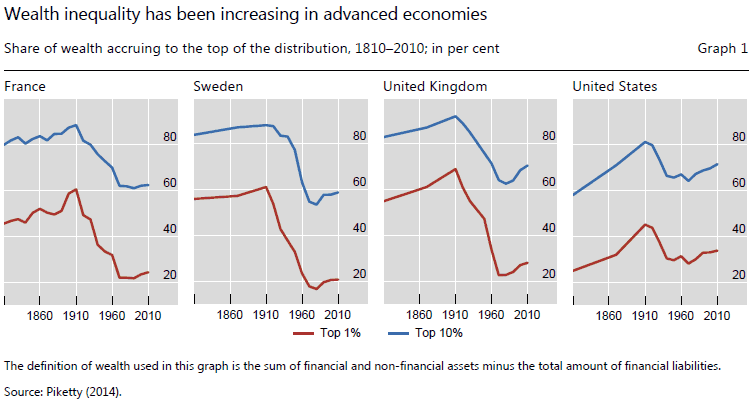
[1] has some actual numbers to answer that question, with e.g. [2] for modern US numbers (since [1] has only Europe). The wealth gap peaked in 1910, took a nose dive until the late 1960s (though much more pronounced in Europe than in the US) and is on the rise since then.
The post-industrial US dipped as low as ~1300 or ~1650 Europe, but is now back to levels Europe only reached in 1750, well on track to repeating the rising inequality during industrialization. Sweden is still at 1280/1600 Europe numbers, better than 1960s USA.
Actually it probably has risen a bit more since then since those are 2010 numbers, hence the comparison of US numbers to the French Revolution
This is not the type of FOSS ecosystem that Stallman wanted to achieve; it's the ecosystem that big business wants: people work for free and profits multiply and accumulate at the top. That is what MIT licensing fosters. If you want a different world, use a different license model.
Unfortunately, the JS world is effectively built on freeloading, so any licensing restriction is seen as a capital sin against "the community" of temporarily-embarrassed-FAANGs. Meanwhile, actual FAANGs laugh all the way to the tax-haven-based bank, and the lone guy in Nebraska/Russia continues to starve.
I have never observed a non-techie do anything other than blindly click the call to action (i.e. agree to everything). The entire scheme seems sneakily designed to actually encourage users to give more and explicit consent, avoiding the situation where consent was a grey area. It seems to have been spun to a great extent.
The other items at least in the US midwest would be ice storms (ice coating power lines making them heavy and branches getting too coated and falling on power lines) and thunderstorms (50+ mph wind coming through bringing down tree branches on to powerlines) or lightning strikes hitting power transformers.
I'm still upset that, at 48:36, Forstall offered to give his thoughts on what we could be doing with AI that we're not, but Markoff decided to move on.
I may very well be wrong, but I live a block away from a Coop, Systembolaget and a few other stores, I can do a quick sample test tomorrow. (I know they have tags similar looking to these but I couldn't swear they're e-ink. I always thought those tags were pretty cool but it drives me nuts when they aren't set and so you have to go around hunting for a price anyway. (Looking at you, Bauhaus!)
The Amiga in 1985 had amazing custom graphics and sound chips, a preemptive multitasking OS, double the RAM of the Mac 128k at 1/2 the price (Mac 128 MSRP is $6000 in 2018 dollars)
It’s really sad how much public hagiography is made over the Mac when almost no middle class family I knew of could afford it, certainly not with a LaserWriter.
The Commodore 64 was way more affordable and got a legion of kids interested in computing and coding, who later went on to adopt Amigas.
Even today if you look at the home brew, hacker, and demo scenes, Commodore dominates. Hardly anyone is doing stuff on old Apple 2s or Macs.
Commodore gets the short shrift in the Twitterati retelling of the personal computer evolution, and today’s millennials completely fixated on Jobs and Apple and ignore most of what was really happening in the 80s with home users.
There was a lot of effort, planning, and training that goes into making sure that there aren't any complications. Not to mention the fact that even routine procedures can have unexpected complications that have to be planned for and addressed. I think that $38k for a surgical procedure with post-operative care for the mother and child isn't necessarily that outrageous. Just imagine the people, training, facilities, etc...
EDIT: Now that I'm thinking about it -- was the $38k bill with or without insurance? Meaning, was this their out of pocket costs with insurance? If so, that does seem rather unreasonable. If that was the billed rate for the insurance company and your friend's out of pocket costs were lower, that would make more sense.